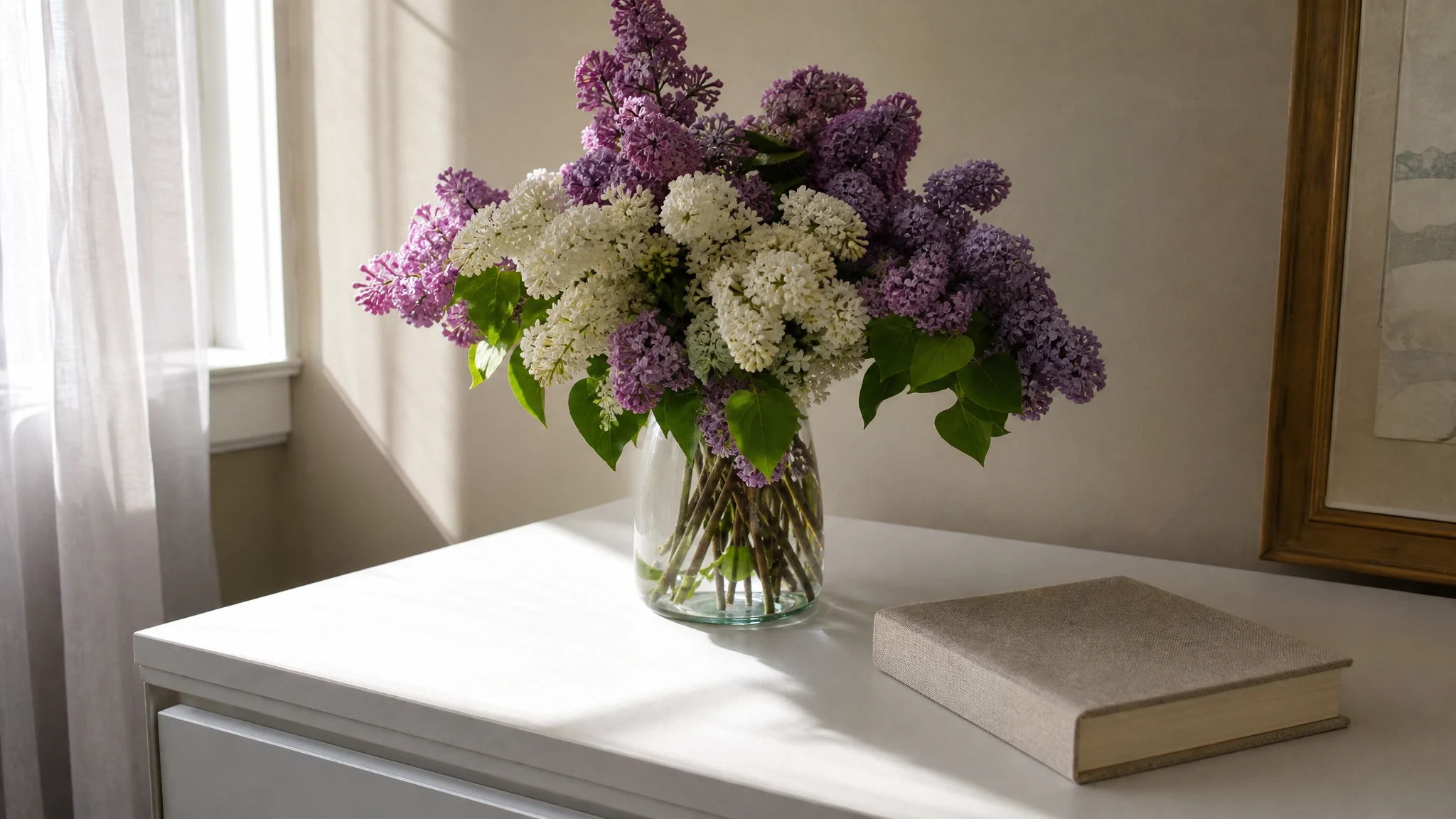
A History of Lilac in Perfumery: Built, Not Pressed
The history of lilac in perfumery is a history of reconstruction. The bloom is one of the best-loved scents in a spring garden, and perfumers still had to build it, because the flower does not hand over a usable oil the way a rose does. Our Lilac Blossom Oil is a composition built to be faithful to the common lilac, and we say so; it sits in that line, not outside it. This essay keeps only what we could verify against a source we read, which is less than most pages on the subject claim, and it lists what we cut.
What the living flower emits is not one fixed smell
Start with the target. A 2016 paper in the Journal of Forestry Research collected floral volatiles from nine Syringa species and varieties by dynamic headspace and identified them by thermal desorption GC-MS. Scent differed significantly in components and amounts between the taxa. β-Ocimene made up more than 70 percent of the floral scent in three of them, including S. vulgaris 'Bright Centennial' (Yang et al., 2016). The same study found that detached 'President Lincoln' flowers drying naturally released mostly alcohols, with 2-ethyl-1-hexanol at about 40 percent of the total.
Two consequences follow, and both are our inference from that abstract, not statements in it. First, "the smell of lilac" depends on which lilac, and on whether the flower is fresh. A perfumer reconstructing it is picking a target, not copying a fixed formula. Second, a dried or crushed blossom is not the same emission as a living one, which is part of why simply processing the petals did not solve the problem. The paper did not set out to explain perfumery history, and it did not test any perfume.
The molecules named in the literature
The compounds most tied to lilac in the chemistry literature are the lilac aldehydes and lilac alcohols. A 2021 paper in Molecules by Dacho and Szolcsányi (Slovak University of Technology) states that lilac aldehydes were first isolated in 1974 from an oil of lilac flowers, Syringa vulgaris, and credits Wakayama and Namba in the Bulletin of the Chemical Society of Japan (Dacho and Szolcsányi, 2021). It adds that the natural (5'S) stereoisomers have odour thresholds one to two orders of magnitude lower than the (5'R) forms, that lilac alcohols also contribute to the scent of the flowers, and that "synthetically prepared lilac aldehydes are used almost exclusively" for perfumery. We have not read the 1974 paper and the review does not say how that oil was obtained, so we cannot tell you whether a distillate, an extract or something else was involved.
There is a disagreement here. Perfume-trade glossaries we came across say the lilac aldehyde and alcohol were first identified in headspace analysis of the live flower. The review dates the first isolation to 1974 from an oil. We follow the peer-reviewed review and flag the conflict; we cannot settle it from sources we read. Since those glossaries are commercial pages, we do not link them.
Terpineol and the question of who "invented" a lilac base
Many lilac histories name α-terpineol as the backbone of early lilac bases. The chemistry behind that is dated and documented, but the perfumery claim is not. Otto Wallach received the 1910 Nobel Prize in Chemistry for his work on alicyclic compounds, and his Nobel lecture of 12 December 1910 discusses converting pinene to terpineol by taking up water (Wallach, Nobel lecture, 1910). A Wiley reference chapter on α-terpineol (Classical Methods in Structure Elucidation of Natural Products) says he isolated a pure sample in 1885 and established its formula as C10H18O. That is a date for the molecule, not a date for lilac perfume. We read both only through search summaries: the Nobel PDF would not open for us in full. Trade pages also say α-terpineol is not found in lilac flowers, a point we could not confirm from a primary source; if true, it is the point: it is a stand-in whose smell reads as lilac, not a copy of what the flower emits. We could not find a primary source for who first sold a terpineol-based lilac base, or when, so no one is credited here. Anyone who gives you a name and a year for that without a patent or an archive behind it is repeating trade lore.
Headspace: measuring the living flower
The 20th-century change was being able to analyse the air around an intact flower. A 2004 Associated Press report on International Flavors & Fragrances described the method: a glass globe over a blooming flower, a retractable needle close to it without touching, scented air collected for about 30 minutes, then computer analysis building a profile that can be recreated repeatedly with synthetic, nature-identical molecules (Critchell, AP, 2004). IFF's Subha Patel said in it that a rose extract and a living rose can differ greatly. The article is about roses and other flowers, not lilac, so it shows how reconstruction is done, not that it was done for any particular lilac fragrance. Accounts of when the industry adopted headspace differ (we saw both the 1970s and the 1980s), so we put no date on adoption.
Timeline of what we could verify
| Date | What the source says | Source |
|---|---|---|
| 1885 | Wallach isolates pure α-terpineol, formula C10H18O (molecule only, not a perfume) | Wiley reference chapter (summary read) |
| 12 Dec 1910 | Wallach's Nobel lecture on alicyclic compounds, including pinene to terpineol | Nobel Prize archive (summary read) |
| 1974 | Lilac aldehydes first isolated from an oil of lilac flowers (Wakayama and Namba) | Dacho and Szolcsányi, 2021 |
| 2004 | Living-flower headspace described for IFF, profile rebuilt with nature-identical molecules | AP, 2004 |
| 2016 | Headspace of nine Syringa taxa: β-ocimene above 70 percent in three | Yang et al., 2016 |
| 2021 | Review: synthetic lilac aldehydes used almost exclusively in perfumery | Dacho and Szolcsányi, 2021 |
What we cut, and why
We name no famous lilac perfume, house or perfumer, because we could not confirm a date, formula or creator for any from a primary or archive page. We searched for a lilac entry in the Osmothèque archive and found none we could cite. We left out the date of hydroxycitronellal, a molecule often placed in lilac accords: the trade pages we found give 1905 and 1908 and none is a primary source. We did not repeat any claim that a true lilac essential oil exists, because no source we read supports it; for that question see why there is no true lilac essential oil.
Where our oil sits in this line
Our pages describe the oil as a composition of botanical extracts and infused aromatics built to be faithful to the scent of the common lilac, Syringa vulgaris, and say we will not publish a formula. The published certificate of analysis for its batch lists extraction method "Blended", parts used "N/A", relative density 0.973, refractive index 1.501 and optical rotation of minus 0.72 degrees, with appearance and smell passing. It lists no constituents, so it does not tell you whether the molecules in this essay are present, and we do not claim they are. What the history suggests is a buyer's rule, not a claim about our bottle: judge a lilac oil by what the seller says it is and what the paper says about it, not by a story that it was pressed from blossoms. For the molecules in plain terms see inside the lilac accord, for the scent itself what lilac smells like, and for the cultural story, which this essay does not repeat, lilac in memory and meaning.
If you want to judge for yourself, smell the oil against the scent of fresh blossoms in May, and ask for any document you need in writing before you order.
Lilac Blossom Oil
Lilac Blossom Oil from our own shop, in sizes from 0.5 oz to bulk.
From $15.99
Shop Now →Sources & Further Reading
- Yang X, Zhao J, Zheng J, et al., 2016. Analysis of floral scent emitted from Syringa plants. J Forestry Res 27(2):273-281. doi 10.1007/s11676-015-0156-3
- Dacho V, Szolcsányi P, 2021. Synthesis and olfactory properties of seco-analogues of lilac aldehydes. Molecules 26(23):7086. pmc.ncbi.nlm.nih.gov/PMC8658798
- Wallach O, 1910. Alicyclic compounds, Nobel lecture, 12 December 1910. nobelprize.org/wallach-lecture.pdf
- Wiley reference chapter, alpha-terpineol, in Classical Methods in Structure Elucidation of Natural Products (read as a search summary; full text blocked). doi 10.1002/9783906390819.ch5
- Critchell S, Associated Press, 2004. Living flower technology makes rose perfume actually smell like a rose. ljworld.com/2004/jul/04