Why Lilacs Smell Stronger at Times: What Is Measured
"Lilacs smell stronger in the evening" and "on warm afternoons" are two of the most repeated claims about the flower, and we could not find a study that measured either for common lilac. What the literature does show is that "smells stronger" bundles two separate things: how much scent the flower emits, and how much of it your nose registers. This post sorts what is measured from what is guessed, and labels every borrowed result as borrowed.
Two questions hiding in one sentence
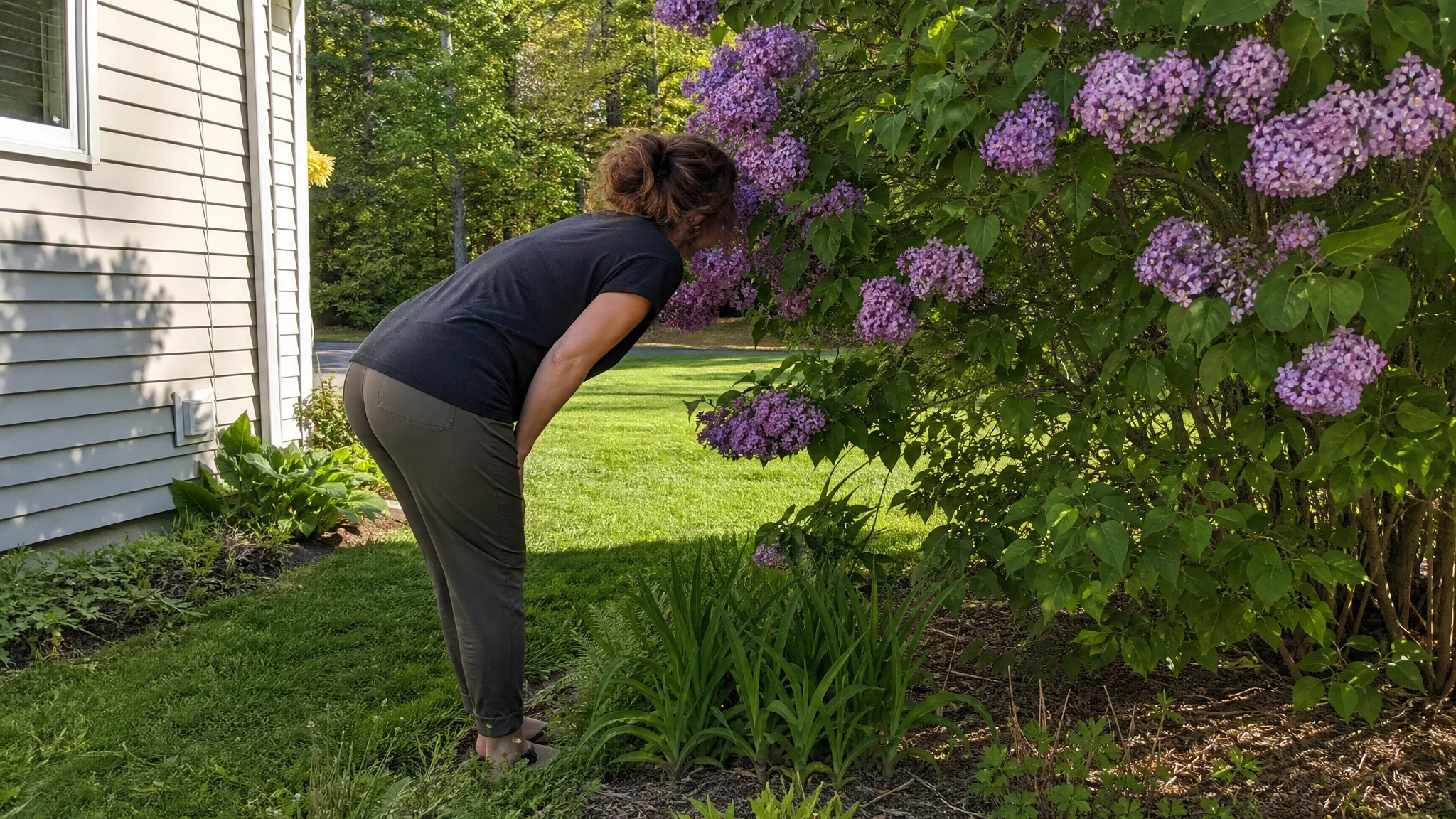
When someone says a lilac hedge smelled stronger at dusk, one explanation is about the plant: the flowers released more volatile compounds into the air. The other is about the person: you came out of a house, or a car, with a nose that had not been exposed to the scent for a while. Both can be true at once, and only the first can be tested on the flower. The rest of this post takes them in that order.
What emission studies show, species by species
The best-documented finding in floral scent biology is that emission is not constant. It is not uniform across flowers either, which matters for how far any result can be carried to lilac. A 2016 review by Fenske and Imaizumi in Frontiers in Plant Science collects the work on circadian rhythms in floral scent (Fenske and Imaizumi, 2016). The table gives what it reports for each species, and what a lilac reader can and cannot take from it.
| Species | What was reported | Carry-over to lilac |
|---|---|---|
| Night-blooming jasmine (Cestrum nocturnum) | A 24-hour emission rhythm persisted for 3 days under constant light and temperature, and detached corolla lobes also showed it (Overland, 1960, as reviewed). | Shows a built-in clock can drive emission in some flowers. Not shown for lilac. |
| Odontoglossum constrictum and Citrus medica | Peak emission during the day, with no rhythm under constant light or constant dark; rhythm returned under day and night cycles. | In these two the light cycle, not a clock, appears to set the timing. |
| Hoya carnosa | Emission only at night; the rhythm persisted in continuous light and darkness and its period showed temperature compensation. | A night emitter. Lilac is not described this way in anything we read. |
| Petunia hybrida | A nightly rhythm that did not persist robustly in continuous light or dark. | A widely studied model plant. The review does not discuss moth or other pollinator timing. |
The four rows show three different patterns, which is the point: some flowers scent on a clock, some on the light cycle, and some peak by day. The review does not mention Syringa anywhere.
Emission also changes with the age of the flower, not only the hour. In Clarkia breweri, Dudareva and colleagues sampled headspace at 12-hour intervals across a flower's life: emission of three benzenoid esters began before the flower opened at 10 to 20% of maximum, stayed fairly stable for about 12 hours after opening, then held at 50 to 75% of peak for roughly 36 to 48 hours and fell sharply after day 3. They saw no marked difference between day and night, with the growth chamber at 22 C in the light and 18 C in the dark (Dudareva et al., Plant Physiology, 1998). That is one annual wildflower, but it is a clear demonstration that "the lilac smelled stronger last week" can be about flower age. A cluster at its freshest, with most florets just opened, is a different emitter than the same cluster a week later.
Does warmth make it stronger? The evidence is not that simple
The intuitive answer is yes: warm compounds evaporate faster. The measured plant evidence is more mixed. In two petunia varieties grown at 22/16 C or 28/22 C (day/night), the higher temperature reduced phenylpropanoid scent production in both the air and the flower tissue, linked to lower expression of scent genes (Cna'Ani et al., Plant, Cell and Environment, 2015). Note what that tested: plants grown warm, not one flower measured at noon versus dusk. It does not answer the afternoon question. It does show that the simple volatility story is not the whole biology.
A 2020 systematic review of floral volatile emission across 305 species from 66 families, drawn from 58 studies, found that climate effects depend on the compound class. Using the 43 species that reported emission in micrograms per hour per flower, total volatiles and monoterpenes showed no significant climate effect, while sesquiterpenes rose with mean annual temperature. The authors flag that the climate values are site averages, not conditions during flowering, and the analysis is correlational (Farre-Armengol et al., Frontiers in Plant Science, 2020). If the dominant lilac compound is a monoterpene, that is a hint that air temperature alone would not set the strength. But that last sentence is inference: the only lilac data point we have is next.
What is known for lilac itself
Very little. Yang and colleagues sampled floral volatiles from nine Syringa species and varieties by dynamic headspace and gas chromatography with mass spectrometry. Beta-ocimene, a monoterpene, made up more than 70% of the floral scent of the S. vulgaris cultivar 'Bright Centennial'. For daytime variation, the page we read reports only that S. pekinensis, a different species, showed significant variation, with benzaldehyde content first increasing and then decreasing, and gives no values or collection times (Yang et al., Journal of Forestry Research, 2016). That is the full extent of what we verified. We found no study measuring common lilac emission across a day and night, after rain, or in different weather, so each of those popular claims is, for lilac, untested in anything we could read.
The other half: your nose adapts
Whatever the flower does, perception falls during sustained exposure. Fallon, Giesbrecht and Stancak exposed 19 adults to a pleasant floral-green fragrance at 0.1% dilution for a continuous 10 minutes and tracked perceived intensity. Attention mattered: with focused attention, the early decline was slower and roughly linear; with a distracting task it was steeper. Later, under focused attention, intensity came back in waves roughly 1 to 2 minutes apart (Fallon et al., Attention, Perception and Psychophysics, 2018). The fragrance was not lilac, the setting was an olfactometer, and the study says nothing about outdoor air. But it supports a plain reading of the garden experience: the first breath on arriving at a hedge is the strongest you will get, and wandering around in it lowers what you notice, whatever the flowers are doing.
Our position, and a way to test it yourself
"Smells stronger at X" is a statement about emission and about your nose, and the second half is the one with a human-subject study behind it. For the first half, bloom stage is the best-supported variable (flower age, from the Clarkia work) and time of day is a species-specific question that has not been answered for common lilac.
If you grow lilacs and want your own answer, this is a design, not a result we have run: pick one shrub, smell the same cluster at the same distance at three set times for a week, rest your nose for several minutes in clean air before each sniff, and note the temperature, the weather and how many florets are open. That separates adaptation from emission better than memory does. The garden guide to which lilac groups bloom when will help you plan the weeks, and the season post covers using the bloom window.
Our own oil is a composition built to be faithful to the scent of the common lilac, so none of the flower-emission findings above describe it. What it smells like is covered in the scent profile; the shop's storage advice is to keep it tightly capped in a cool, dark place.
Lilac Blossom Oil
Lilac Blossom Oil from our own shop, in sizes from 0.5 oz to bulk.
From $15.99
Shop Now →Sources & Further Reading
- Fenske M.P., Imaizumi T., 2016. Circadian rhythms in floral scent emission. Frontiers in Plant Science 7:462. pmc.ncbi.nlm.nih.gov/articles/PMC4829607
- Dudareva N., Raguso R.A., Wang J., Ross J.R., Pichersky E., 1998. Floral scent production in Clarkia breweri III. Plant Physiology 116(2):599-604. pmc.ncbi.nlm.nih.gov/articles/PMC35117
- Cna'Ani A. et al., 2015. Petunia x hybrida floral scent production is negatively affected by high-temperature growth conditions. Plant, Cell and Environment 38(7):1333-1346. cris.huji.ac.il
- Farre-Armengol G. et al., 2020. Deciphering the biotic and climatic factors that influence floral scents. Frontiers in Plant Science 11:1154. frontiersin.org/10.3389/fpls.2020.01154
- Yang X. et al., 2016. Analysis of floral scent emitted from Syringa plants. Journal of Forestry Research 27(2):273-281. doi 10.1007/s11676-015-0156-3
- Fallon N., Giesbrecht T., Stancak A., 2018. Attentional modulation of desensitization to odor. Attention, Perception and Psychophysics 80(5):1064-1071. pmc.ncbi.nlm.nih.gov/articles/PMC6061002