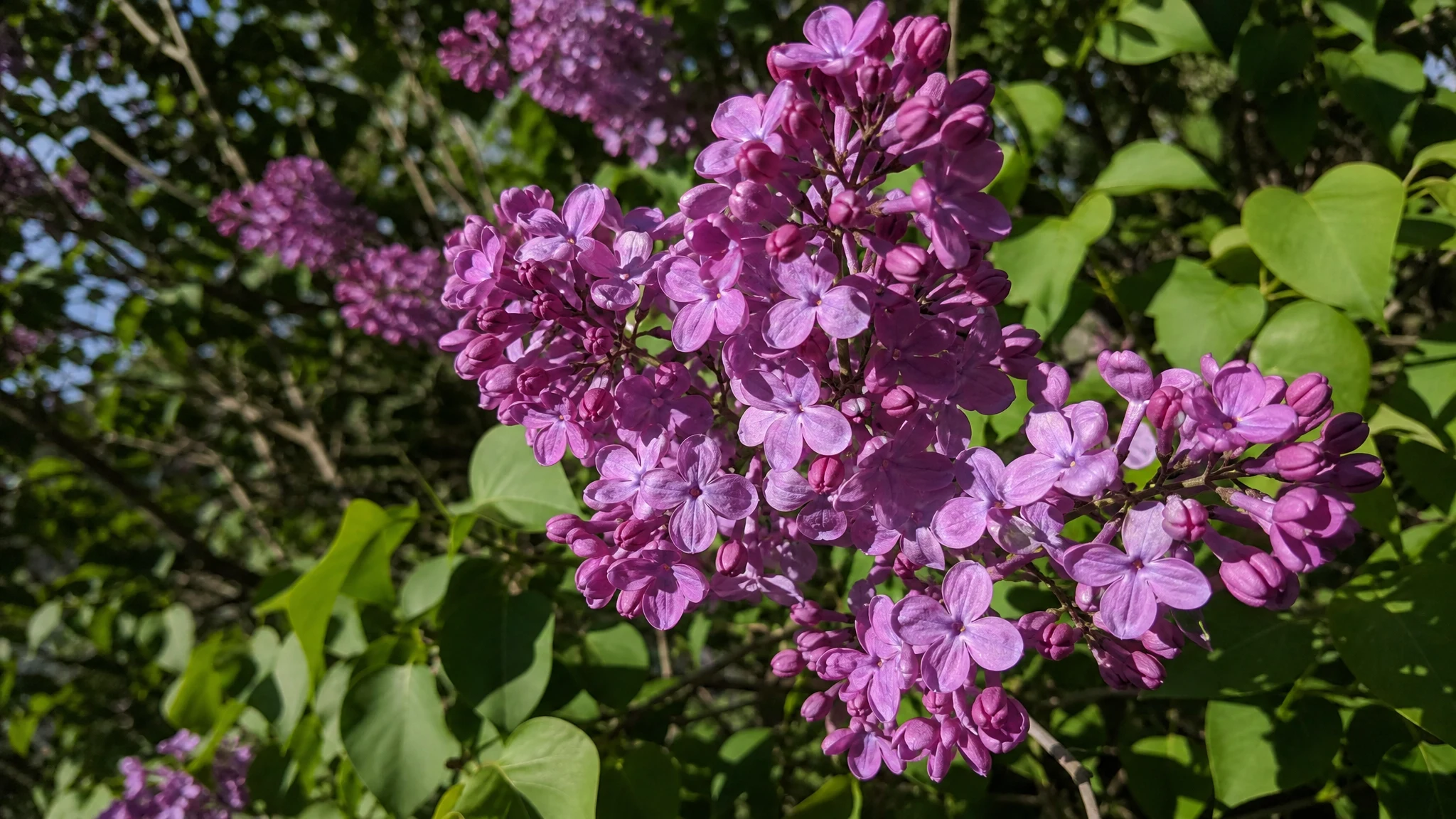
Most Fragrant Lilac Varieties: What the Sources Say
No source we could find ranks lilac varieties by measured scent strength, so any list that crowns "the most fragrant lilac" is repeating gardeners' descriptions, not data. What the extension and arboretum pages do give you is a clear map of which lilac groups bloom when, which ones are described as fragrant in what words, and where those descriptions disagree. This post lays that map out and says how to choose.
What the sources describe, group by group
The table uses only pages we read in full for this post: University of Minnesota Extension's lilac table, NC State Extension's plant pages, the University of Nebraska-Lincoln's Miss Kim page, and the Central Experimental Farm's bloom-time rows. Wording in quotation marks is the source's. Where a page gave no scent description for a group, the cell says so, rather than borrowing one from a nursery listing.
| Group (accepted botanical name as the source gives it) | Bloom timing as sourced | Scent wording as sourced | Hardiness as sourced |
|---|---|---|---|
| Early or hyacinth lilac (Syringa x hyacinthiflora) | Minnesota: early spring, April to mid-May. NC State: up to ten days before common lilac. | NC State tags it "fragrant flowers" and gives no description of the scent. | Zones 3 to 7 (Minnesota, NC State) |
| Common lilac (Syringa vulgaris) | Minnesota: mid-spring, mid to late May. NC State: mid- to late spring. | NC State: "The pungently sweet fragrance is delightful but can be overpowering to some individuals." | Zones 3 to 7 (Minnesota); 3a to 7a (NC State) |
| Manchurian or Korean lilac (Syringa pubescens subsp. patula, including 'Miss Kim') | Minnesota: mid-spring. Nebraska: a little after common lilac. NC State: late spring to early summer. | NC State: "sweetly fragrant," "a spicier scent" than common lilac. Nebraska: "a strong, pleasant fragrance." | 3a to 8b (NC State) |
| Preston lilac (Syringa x prestoniae) | Minnesota: late spring, the late bloomers. | The pages we read give no scent description. | Zones 3 to 7 (Minnesota) |
| Japanese tree lilac (Syringa reticulata) | NC State: June, about two weeks. Ottawa farm: the very late group, usually starting the second week of June. | NC State: "a musky, privet-like scent," lacking the typical lilac sweetness. | 3a to 7b (NC State) |
Sources for the table: University of Minnesota Extension; NC State Extension plant pages for early lilac, common lilac, Manchurian lilac and Japanese tree lilac; University of Nebraska-Lincoln, Miss Kim lilac; Friends of the Central Experimental Farm, Ottawa.
Where the sources disagree, and why it matters
The Miss Kim row shows it. Minnesota files the Manchurian lilac in the same mid-spring group as common lilac, Nebraska says a little after, and NC State says late spring to early summer. These are different states, so some of the gap is geography, but it is also a reminder that bloom order is a rule of thumb. Compare the Ottawa farm, which puts its earliest group in the second week of May and its very late group in the second week of June: a four-week spread inside one collection.
The scent words disagree in kind, not only in degree. NC State calls common lilac "pungently sweet" and warns it can overpower some people, then calls Miss Kim's scent spicier than common lilac's. Nebraska says only "strong, pleasant." Those are descriptions by different writers with different noses, none of them measurements. The Japanese tree lilac is the clearest case that "lilac" is not one smell: a page from the same extension service describes it as musky and privet-like and says it lacks the typical sweetness.
One more disagreement is practical. NC State's Extension Gardener feature reports that common lilac does not tolerate the heat of the state's warmer regions and often gets powdery mildew and borers, and that the hyacinthiflora group was among the best choices for the Piedmont and coastal plain in the author's cited 20 years of trials. It also notes that Miss Kim was publicized as heat tolerant, a claim it presents as a claim, not a confirmed result (NC State Extension Gardener, updated 13 November 2023). A variety can win on scent description and lose on whether it survives your summer.
What measurement exists, and what it does not show
The closest thing to data is a headspace study. Yang and colleagues compared floral volatiles from nine Syringa species and varieties, four of them cultivars of S. vulgaris, using dynamic headspace sampling and thermal desorption gas chromatography and mass spectrometry (Yang et al., Journal of Forestry Research 27(2), 2016). In the cultivar 'Bright Centennial', one compound, beta-ocimene, made up more than 70% of the floral scent. The abstract page we read gave no full compound tables or collection times, and daytime variation was reported for a different species (S. pekinensis). Chemistry like this describes what is in the air above the flower. It does not say how strong a person finds it, and it does not rank varieties. Our post on why lilac scent seems stronger at times goes into what that does and does not tell you.
How to choose, given all that
Our position: choose by bloom season first, then by your own nose at a nursery, and treat the cultivar name as a weak guide. The reasoning is plain from the table. The groups do not bloom together, so a hyacinthiflora, a common lilac and a Preston planted in one yard give you roughly a month of flowers, not three plants competing for one week. And the written scent descriptions are too varied, and too subjective, to separate named cultivars inside a group.
- Visit in bloom. Go to a nursery or arboretum while the lilacs are open, which is the point of the Ottawa and Minnesota timing rows. A plant bought in a pot in winter has no scent to judge.
- Sniff several plants in one visit. Your own sense of smell fades with continuous exposure, so rest your nose between plants. A controlled study of 19 adults exposed to a floral-green fragrance for 10 minutes found perceived intensity declined over the exposure (Fallon et al., 2018), and that is one fragrance in a lab, not lilacs in a garden.
- Check your zone and summer heat first. Hardiness numbers above are the sources' ranges; your local extension office knows your conditions.
- If you want a long season, plan the groups. Early, mid and late types, as sourced above, stretch it.
Where our oil sits
Our lilac oil is a composition of botanical extracts and infused aromatics built to be faithful to the scent of the common lilac, and the shop does not specify a species or cultivar. It is not made from any particular variety in this table, and nothing here says one cultivar would be a better model for it than another. The scent profile describes what the oil is meant to smell like, and why there is no true lilac essential oil explains why a composition exists at all. For the shrub itself, the botanical profile already covers the common lilac, so we did not repeat it here.
The oil is for scenting candles, soap, body products and rooms; the shrubs in this guide come from a nursery. If you can only buy one, buy the plant in bloom, and use the oil when the bloom is over.
Lilac Blossom Oil
Lilac Blossom Oil from our own shop, in sizes from 0.5 oz to bulk.
From $15.99
Shop Now →Sources & Further Reading
- University of Minnesota Extension. Lilacs. extension.umn.edu/trees-and-shrubs/lilacs
- NC State Extension. Syringa x hyacinthiflora (early flowering lilac). plants.ces.ncsu.edu/syringa-x-hyacinthiflora
- NC State Extension. Syringa vulgaris (common lilac). plants.ces.ncsu.edu/syringa-vulgaris
- NC State Extension. Syringa pubescens subsp. patula (Manchurian lilac, 'Miss Kim'). plants.ces.ncsu.edu/syringa-pubescens-subsp-patula
- NC State Extension. Syringa reticulata (Japanese tree lilac). plants.ces.ncsu.edu/syringa-reticulata
- NC State Extension Gardener, updated 2023. In Search of Lilacs for the South. extensiongardener.ces.ncsu.edu
- University of Nebraska-Lincoln. Miss Kim lilac. byf.unl.edu/miss-kim-lilac
- Friends of the Central Experimental Farm, Ottawa. Lilacs: rows by bloom time. friendsofthefarm.ca/lilacs
- Yang X. et al., 2016. Analysis of floral scent emitted from Syringa plants. Journal of Forestry Research 27(2). doi 10.1007/s11676-015-0156-3
- Fallon N., Giesbrecht T., Stancak A., 2018. Attentional modulation of desensitization to odor. Attention, Perception & Psychophysics 80(5). pmc.ncbi.nlm.nih.gov/articles/PMC6061002