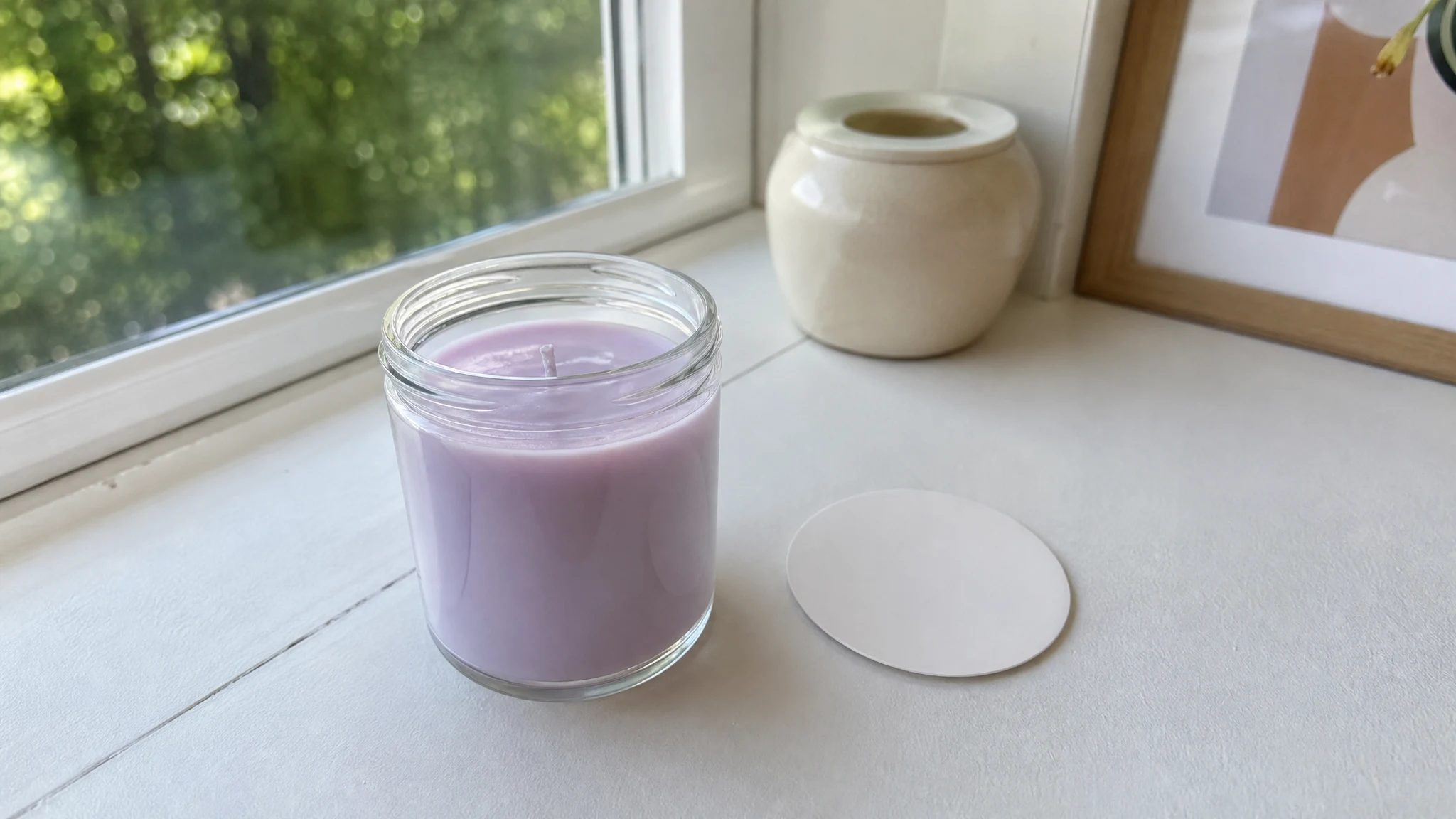
Candle Warning Label Requirements in the US: Law vs Standard
A candle label is a legal and liability document before it is branding, and this post cannot tell you what yours must say: that takes a product-safety attorney or a testing lab. What it can do is separate what is law from what is a voluntary standard, using the US federal sources read on 2026-10-27, and say where we could not read the primary text.
Layer one: what is law
| Requirement | What the source says | Source |
|---|---|---|
| Lead in metal-cored wicks | Must not contain lead in the metal core in excess of 0.06% by weight (16 CFR 1500.17(a)(13)); applies to products made or imported on or after October 15, 2003. Bulk shipments carry the statement "Conforms to 16 CFR 1500.17(a)(13)" on the shipping package, not on retail packaging. No certification is required for nonmetal-cored wicks or candles using them. | CPSC, Candles business guidance |
| Cautionary labeling | "Candles that contain a hazardous substance as defined under the FHSA must bear cautionary labeling." | Same CPSC page |
| Consumer commodity labels | The Fair Packaging and Labeling Act asks for identity of the commodity, net quantity (metric and inch/pound) and name and place of business. The FTC page does not mention candles. | FTC, FPLA regulations |
The middle row is the one makers misread. The CPSC page does not say every candle needs a Federal Hazardous Substances Act label. It says a candle that contains a "hazardous substance" does. In the regulation, 16 CFR 1500.3, a hazardous substance can be toxic, corrosive, an irritant, a strong sensitizer or flammable or combustible, if it can cause substantial personal injury or illness in customary or foreseeable use. "Flammable" there is a flashpoint above 20 F and below 100 F (37.8 C). Whether a given scented candle crosses a line depends on its materials and a legal determination, and we did not find a CPSC statement that settles it for scented candles in general. That determination belongs to a product-safety attorney or accredited lab, not to a seller of oil.
If an FHSA label does apply, 16 CFR 1500.121 sets the form. The signal word (DANGER, WARNING or CAUTION), the statement of principal hazard and any instruction to read other cautions must be blocked together in a rectangle on the principal display panel, with a minimum type height that rises from 3/64 inch for a small panel, and the hazard statement in capitals. Letter height may be no more than three times letter width.
The FPLA row has a limit of its own. Because the FTC page does not name candles, we cannot tell you whether it governs yours; the page notes that many exempt products fall under state weights and measures laws. We did not check any state rule, including California's, and a seller across several states should ask.
Layer two: ASTM F2058, voluntary unless something makes it binding
The CPSC page lists six ASTM candle standards, including F2058 for fire safety labeling, F2179 for glass containers, F2326 for visible emissions and F2417 for candle fire safety, and describes them as industry consensus (voluntary) standards. It does not say any is mandatory. The ASTM store page shows the active edition as F2058-07(2021), last updated May 24, 2022. Its public abstract says the specification covers fire safety information on candle units of sale, with requirements for retailers and distributors too, and that it does not address other labeling requirements.
From that abstract: the warning goes on the unit of sale, must be visible at the point of sale, and nobody in the supply chain may cover, obstruct or remove it. A text-only warning begins with the safety alert symbol followed by "WARNING" in uppercase boldface; a text-and-pictogram warning begins with the symbol followed by the pictograms. The standard is paywalled, and we did not read it. We therefore cannot list the required statements and will not reconstruct them from competitors' labels, which may be wrong or out of date. Buy the standard if you label for sale. It runs to nine pages, according to the ASTM page.
The older CPSC voluntary-standards page, dated June 6, 2011, says CPSC staff take part in ASTM subcommittee F15.45 on candles, and gives a four-year average (1999 to 2002) of about 12,500 candle fires a year, 110 deaths and 1,100 injuries. That is why the warnings exist. Reporting on NFPA's 1999 data, Fire Engineering (2003) says about four in ten candle fires involved candles left unattended, abandoned or inadequately controlled and about one in four involved flammable items too close to the flame. These are old figures, quoted for their date, and they reason toward what a warning must address; they are not a label text.
Voluntary can still bind you by contract: a retailer or marketplace can write a standard into its vendor terms. We could not read a retailer's terms (the one document we requested returned an access error), so we cannot say how common this is; read the agreement you are about to sign.
Layer three: what your fragrance supplier supplies
Your label has to reflect what is in the candle, so it starts with documents from your suppliers. A safety data sheet is the baseline: OSHA's Hazard Communication rule lists sixteen sections, with Section 2 for hazards and Section 9 for physical and chemical properties including flash point. See fragrance oil flash point explained and how to read a fragrance oil COA and SDS.
Our site publishes no SDS, flash point or IFRA certificate for Lilac Blossom Oil, and the COA shows only appearance, smell, relative density (0.973), refractive index (1.501) and optical rotation (minus 0.72 degrees) for the batch it covers. If you pour candles to sell, ask in writing before ordering for the safety documents you need and get the answer in writing. Do not infer a hazard classification from the absence of a sheet. We do not state one for the oil, and a label cannot rest on silence.
Order of work
- Settle what you make: container candle, pillar or melt. Wax melts have their own post, how to make lilac wax melts.
- Collect the documents: wax, wick (metal or nonmetal core), fragrance SDS, container.
- Ask an attorney or testing lab whether FHSA cautionary labeling applies to your exact candle.
- Buy ASTM F2058 and follow it for the warning.
- Add the FPLA items (identity, net quantity, name and place of business) after confirming whether they apply to you.
- Test the candle itself, not only the label: see what to check when a lilac candle will not throw.
The label belongs to the person who sells the candle, so treat this page as a map of the sources and take the final wording to a professional.
Lilac Blossom Oil
Lilac Blossom Oil from our own shop, in sizes from 0.5 oz to bulk.
From $15.99
Shop Now →Sources & Further Reading
- US Consumer Product Safety Commission, undated (read 2026-10-27). Business guidance: Candles. cpsc.gov/Business-Guidance/Candles
- US Consumer Product Safety Commission, 2011 (read 2026-10-27). Voluntary standards: Candles. cpsc.gov/Voluntary-Standards/Topics/Candles
- ASTM International, 2022 page (read 2026-10-27). F2058-07(2021), Standard Specification for Candle Fire Safety Labeling, abstract only. store.astm.org/f2058-07r21
- US Government, 16 CFR 1500.3 and 1500.121 (current eCFR, read 2026-10-27). ecfr.gov/title-16/1500.121
- Federal Trade Commission, undated (read 2026-10-27). Fair Packaging and Labeling Act regulations. ftc.gov FPLA regulations
- Fire Engineering, 2003 (reporting NFPA data). Home fires from candles reach 20-year peak. fireengineering.com
- US Government, 29 CFR 1910.1200(g)(2) (current eCFR, read 2026-10-27). ecfr.gov/title-29/1910.1200