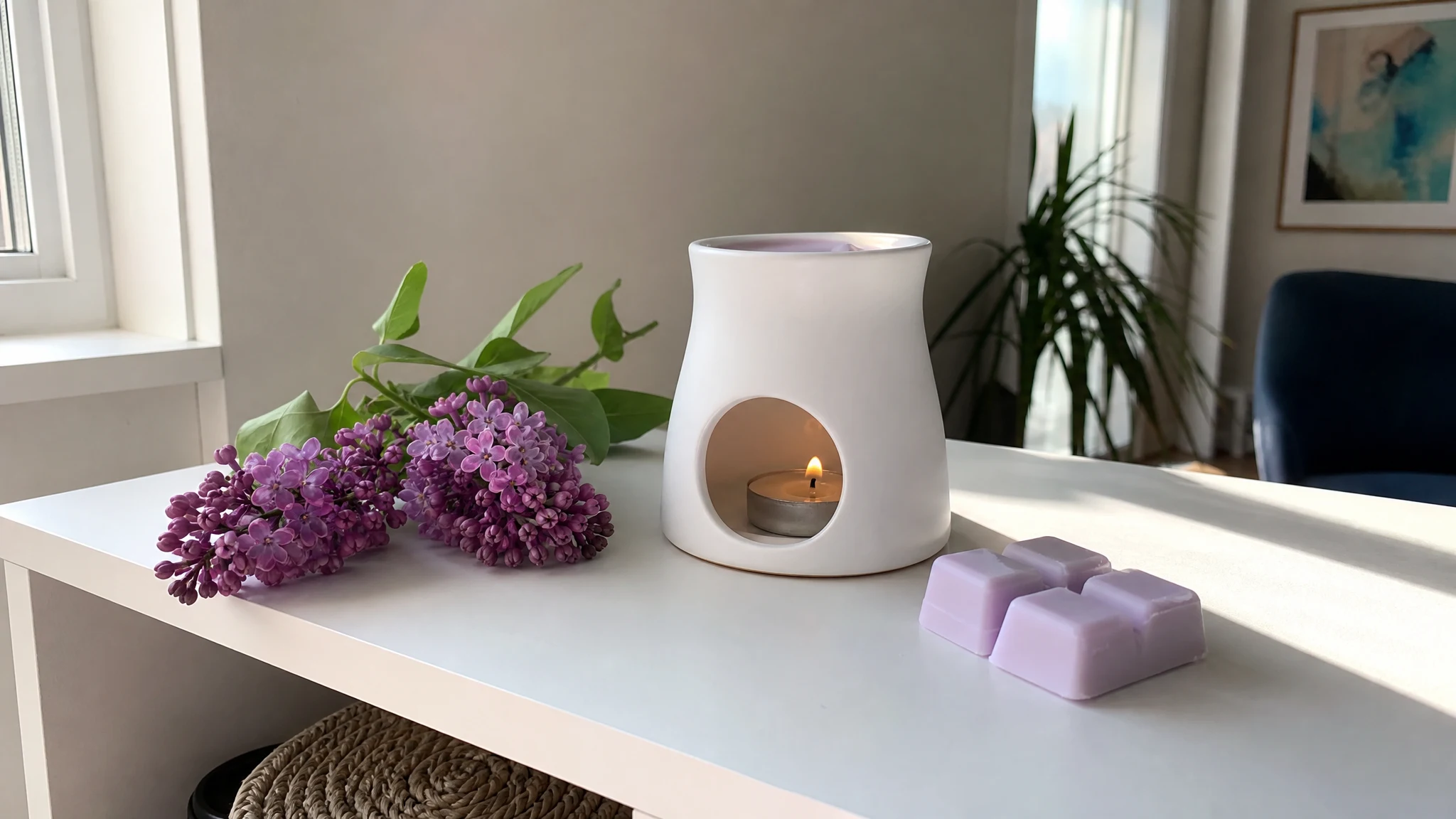
How to Make Lilac Wax Melts: The Arithmetic and the Order
Wax melts are the cheapest place to try a new oil because there is no wick to size and no flame to trim, but "no flame" is not the same as "no heat". This post walks the order a maker should follow: pick the wax, do the arithmetic from grams of wax to grams of oil, melt and pour, cure, then think about the warmer. We have not made these melts, and nothing here is a tested recipe.
Decide the wax and mould first
Melt waxes are a different product from container waxes. A soy melt wax from AAK, sold as Golden Brands GW 494, is described on a retailer listing (Voyageur Soap and Candle, undated) as designed for melts and tarts, not wicked candles, with a 120 to 130 F melt point, an 8% to 12% load and a 155 to 165 F pour range. The listing says pour temperatures should be checked "according to seasonal changes". Do not use a melt wax in a candle, and do not use a container wax in a warmer on the strength of this post.
| Melt wax (source of figure) | Stated load | Temperatures stated | Other printed notes |
|---|---|---|---|
| Soy, GW 494 (retailer listing) | 8% to 12%, about 12% maximum | Pour 155 to 165 F, start at 160 F | Melt point 120 to 130 F |
| Soy, palm and coconut blend BW 923, Blended Waxes Inc. (retailer listing) | up to 15% maximum | Pour 160 to 180 F, start at 160 to 170 F | Melt point 125 F; store away from heat; very hot pours "can also damage the plastic clamshell" |
| Coconut and food-grade paraffin cube wax C55 (retailer listing) | 8% to 10%, "higher fragrance loads should be tested per fragrance" | Heat to 190 to 200 F, add oil, stir 60 seconds, pour near 170 F | One-week cure; for clamshells, pour 85% of the container, let it cool, then pour the rest |
Two of these wax listings reach 12% or 15%, past the 9% to 10% that most of the container waxes in our wax comparison print. That headroom is why melts forgive a first test better than candles do, though the BW 923 listing's customer reviews, which the listing itself carries, mention greasiness and softness even at its 15% load. Treat the ceiling as a limit, not a target.
A caution on sources: these are retailer listings that repeat the maker's figures, not the makers' own technical data sheets, which we could not retrieve (two maker sheets returned access errors). Prices, lots and formulas change, so before you buy, ask the seller for the current sheet and let it override the table. Also note what the listings do not give: none says how a given wax behaves with a floral composition,, and none gives a flash point for the oil you will add.
The arithmetic: grams of wax to grams of oil
Oil weight equals wax weight times the load percentage. Weigh both on a scale reading to 0.1 g. For 100 g of melt wax:
| Load | Oil by weight | Oil by volume (relative density 0.973) | Drops at about 20 per ml |
|---|---|---|---|
| 3% | 3 g | 3.1 ml | about 62 |
| 6% | 6 g | 6.2 ml | about 123 |
| 8% | 8 g | 8.2 ml | about 164 |
| 12% | 12 g | 12.3 ml | about 247 |
The relative density of 0.973 is the figure on the COA we publish for the batch it covers, so 1 ml of our oil weighs about 0.973 g. Drop counts vary with the dropper and the oil, so use the grams. As a stock check, a 0.5 oz bottle holds about 14.4 g of oil, which is enough for about 180 g of wax at 8%, or 480 g at 3%; a 1 oz bottle holds about 28.8 g, or about 360 g of wax at 8%. These rows are a conversion table, not a recommended load for our oil. We publish no load for it, and the reason is on the next point.
Melt, add, pour, cure
- Melt the wax to the maker's stated temperature and no hotter; the C55 listing says 190 to 200 F, the others pour lower. Check it with a thermometer, not by guessing.
- Weigh the oil into the melted wax off the heat, stir for the time the maker states (60 seconds on the C55 listing), and pour in the pour range.
- Pour into the mould or clamshell. A pour that is too hot can warp a plastic clamshell (the BW 923 listing).
- Cool undisturbed, then wait for the wax's own period before judging scent. The C55 listing asks for one week before the best cold and hot throw. Judging on day one is the common way to decide a good melt is a weak one.
One thing this post will not tell you is how long a melt will scent a room. None of the listings above gives a duration, and we have none for our oil.
Why a warmer is not a free pass
A wax warmer heats the melt from a plate, so the oil sits on a hot surface for hours. The question to put to whoever sells you the oil, if you sell finished melts or warmers, is the same one as for candles: the flash point, and the safety data sheet that carries it. We looked for a primary standard on wax warmers and could not read one, so we cannot say what a warmer plate reaches or what a warmer must pass. The warmer's own maker is the source for that; follow its instructions and use a product that carries a recognised certification mark. On what flash point does and does not tell you, see fragrance oil flash point explained.
Where our oil fits
Our Lilac Blossom Oil is a composition of botanical extracts and infused aromatics built to be faithful to the scent of the common lilac, sold neat in nine sizes from 0.5 oz to 400 lb. Our bulk page says it has "decent throw in wax melts and cold-process soap, though like most florals it reads softer than heavier musks or woods," and that testing the fragrance load at a small scale first is worth the extra step. That is the shop's guidance, not a result. The site publishes no flash point, SDS or IFRA certificate for it, so if you plan to sell melts, ask in writing before ordering and get the answer in writing. The COA shows only appearance, smell, relative density, refractive index and optical rotation. Make one 100 g pour first, on the arithmetic above, and if it reads faint after the cure, see what to check before adding more oil. Labels for sold melts are a separate question; see candle warning label requirements. Wax, moulds, clamshells and warmers come from a candle supply shop, not from us.
Start with a 100 g pour, weigh everything, and let the cure finish before you decide the oil is the problem.

Lilac Blossom Oil
Lilac Blossom Oil from our own shop, in sizes from 0.5 oz to bulk.
From $15.99
Shop Now →Sources & Further Reading
- Voyageur Soap and Candle, undated (read 2026-10-27). Golden Brands GW 494 Wax Melt and Tart Soy Wax listing (manufacturer AAK per listing). voyageursoapandcandle.com/golden-brands-gw-494
- Voyageur Soap and Candle, undated. Blended Waxes BW 923 Natural Tart/Melt Wax Blend listing (manufacturer Blended Waxes Inc.). voyageursoapandcandle.com/blended-waxes-bw-923
- Windy Point Soap, undated. Caluxe Coconut Tart Wax C55 listing. windypointsoap.com/products/caluxe-coconut-tart-wax-c55