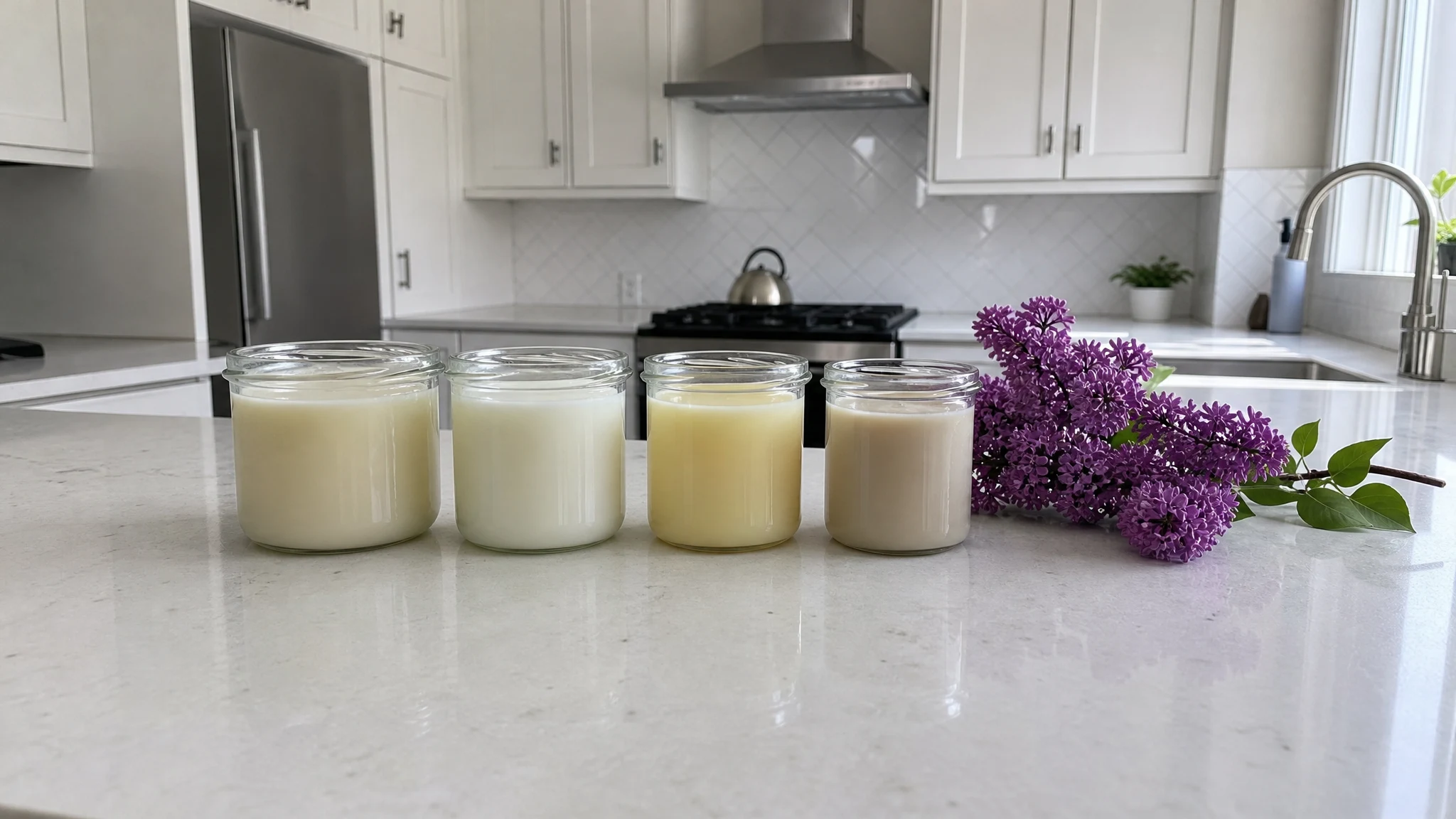
Best Wax for Lilac Candles: Choose by Job and Load Ceiling
No wax is "best" for a lilac candle. A wax is right or wrong for the job (container, pillar or melt) and for the fragrance ceiling its maker prints, and a floral composition like our Lilac Blossom Oil does not change that. This post compares waxes using only figures from wax sellers' own pages, read on 2026-10-27, and says where those figures disagree.
Start with the ceiling, not the brand
The number that matters is the maximum fragrance load: the most fragrance oil, by weight of wax, that the maker says the wax will hold. A wholesale supplier defines it as the highest amount a specific wax can hold based on the manufacturer's guidance, and warns that going over it can cause "poor burning characteristics" and seepage (Wholesale Supplies Plus, undated). So the first question is never "which wax smells strongest" but "how many grams of oil does this wax take, and what happens at the edge?"
What the data sheets and product pages say
These are the figures as printed. They describe each wax with that seller's own fragrance oils, not with our oil, and none of the pages is a test of lilac.
| Wax (source of figure) | Melt point | Stated load | Temperatures stated | Notes printed by the seller |
|---|---|---|---|---|
| Soy, Golden Brands 464 (CandleScience product page) | 113 F (45.0 C) | 10% containers, 6% tealights | Add fragrance at 185 F (85 C), stir two minutes; pour at 135 F (57.2 C) | Cure two weeks; "a little too soft for the summer heat" |
| Coconut-apricot blend, CandleScience's own (product page) | 121 to 131 F (49.4 to 55.0 C) | 10% listed for containers | Pour at 170 F (plus or minus 5 F) | Page says the paraffin in the blend "is key to this wax's strong fragrance throw"; cure "one to two days" |
| Coconut-apricot blend BW 924, Blended Waxes Inc. (retailer listing) | 112 F typical | 9% maximum | Pour 160 to 170 F | "We always recommend experimentation" for pour temperature |
| Paraffin, single-wax use (retailer listing, maker not named) | about 60 C | 3% to 5% "if using only paraffin" | Add at 75 to 79 C; pour 70 to 75 C | Load depends on fragrance strength |
| Paraffin container wax Kerawax 4140 (retailer listing) | 57 C | up to 12% | Heat to about 70 C; pour 60 to 65 C | Listing does not name the maker |
| Beeswax (retailer listing) | "60 degrees" (and a separate "melting temp" of 75) | 6% to 8% | Not clear from the page | "Do not over fragrance as this can be a fire hazard" |
Where the sources disagree
Paraffin is the clearest case. One seller says 3% to 5% when paraffin is the only wax. A wholesale supplier says straight paraffin is limited to about 3% without an additive such as Vybar. Another listing prints 12% for Kerawax 4140. These are not contradictions so much as different products: the 12% figure belongs to a formulated container wax, the 3% to 5% to plain paraffin. The practical lesson is that the word "paraffin" tells you nothing; the ceiling comes from the specific product's sheet.
Soy and coconut blends disagree on cure. The 464 page asks for two weeks. The coconut-apricot page says one to two days, while the same seller's lab notes say cold throw was strong after 24 hours and improved slightly after one week (CandleScience lab notes, undated). Those lab notes also report the wax held its test fragrance oils up to 15%, kept its shape up to 13%, and that some candles at 15% melted out of their containers within 24 hours. A wax can hold a load and still fail as a candle, which is why we would treat the seller's recommended figure, not the maximum anyone has seen it absorb, as the ceiling.
Decide by job
- Container candle, cool climate, wanting a short cure: a coconut-apricot blend has the shortest printed cure and the highest listed hot-throw claim, but that claim is the seller's, rests on a blend containing paraffin by the seller's own account, and was rated on that seller's own scale at 6%. If you want an all-vegetable wax, the data above does not tell you whether a given blend is one.
- Container candle, soy: 464 is soft (113 F melt point) and its own page flags summer heat; it is also the wax with the longest printed cure. Our live post on scenting soy candles with lilac oil owns the soy steps, so we will not repeat them here.
- Beeswax: we found no maker's data sheet in this search, only one retailer listing, with a melt point that contradicts itself and no throw data. We would not recommend beeswax for lilac on that evidence, and we cannot say it is worse either.
- Pillars: none of the pages above is a pillar wax sheet, so this post does not rank pillar waxes. Ask the wax maker.
- Melts: a different set of waxes with higher stated loads; see how to make lilac wax melts.
Arithmetic: what a ceiling means in grams
Take a container holding 250 g of wax. At a 6% load that is 15 g of oil; at 10% it is 25 g. Going from 6% to 10% adds 10 g, which is 67% more oil, and the wax is then at the edge of the 464 sheet's ceiling. To double a 6% load you would need 12%, past every container ceiling in the table except Kerawax 4140. That is the case against "just add more": the headroom is thin.
If the oil were our Lilac Blossom Oil, the COA we publish gives a relative density of 0.973, so 15 g is about 15.4 ml, roughly 308 drops at about 20 drops per ml, and 25 g is about 25.7 ml or roughly 514 drops. Weigh instead of counting drops. These conversions are arithmetic only. They are not a recommended load for our oil.
Where our oil fits, and where it does not
Our oil is a composition of botanical extracts and infused aromatics built to be faithful to the scent of the common lilac, sold neat. Our bulk page says it has "decent throw in wax melts and cold-process soap, though like most florals it reads softer than heavier musks or woods," and that testing the fragrance load at small scale before committing bulk oil is worth the extra step. That is the shop's guidance, not a result from any pour.
The site publishes no flash point, SDS or IFRA certificate for the oil, and the COA lists appearance, smell, relative density, refractive index and optical rotation only. If you are pouring candles to sell, ask in writing before ordering for flash point and safety data and get the answer in writing. We have not poured any of these waxes with the oil. Pour one small test per wax, one variable at a time, and judge it after the wax maker's cure time. For why a flash point matters and what it does not decide, see fragrance oil flash point explained; if the result is faint, see what to check before adding more oil. We sell the oil only; wax, wicks and jars come from a candle supply shop.
Choose the wax by the job and its printed ceiling, and treat any ranking that skips the ceiling as a sales page.
Lilac Blossom Oil
Lilac Blossom Oil from our own shop, in sizes from 0.5 oz to bulk.
From $15.99
Shop Now →Sources & Further Reading
- CandleScience, undated (read 2026-10-27). Golden Brands 464 Soy Wax product page. candlescience.com/wax/golden-brands-464-soy-wax
- CandleScience, undated. Coconut Apricot Wax product page. candlescience.com/wax/candlescience-coconut-apricot-wax
- CandleScience, undated. Lab notes: CandleScience Coconut Apricot Wax. candlescience.com/lab-notes-candlescience-coconut-apricot-wax
- Voyageur Soap and Candle, undated. Blended Waxes BW 924 listing (figures attributed to Blended Waxes Inc.). voyageursoapandcandle.com/products/blended-waxes-bw-924
- SA Candle Supply, undated. Fully refined paraffin and beeswax powder listings. sacandlesupply.co.za/paraffin
- Supplies for Candles, undated. Paraffin Container Wax, Kerawax 4140 listing. suppliesforcandles.co.uk/paraffin-container-wax
- Wholesale Supplies Plus, undated. What does the maximum fragrance load of a wax mean? help.wholesalesuppliesplus.com