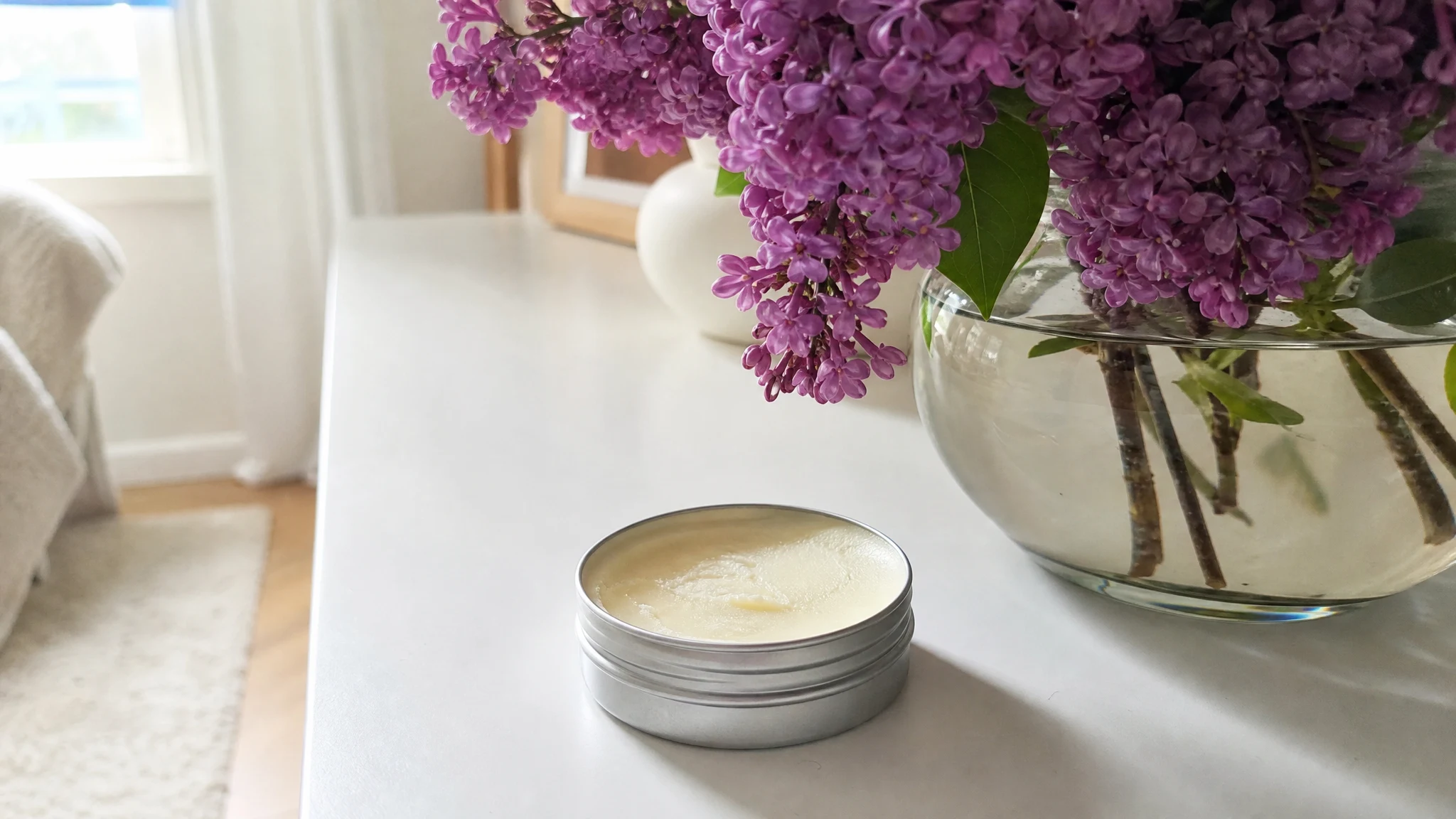
DIY Lilac Solid Perfume: The Arithmetic for a Beeswax Balm
A solid perfume is the lowest-effort way to wear a diluted lilac scent, because the dilution is built into the tin: the oil is already spread through wax and a liquid carrier before it touches skin. It is also a quiet format. At the 0.5% to 2% ceiling in our own copy, a balm will sit closer to the skin than a spray, and this article lays out the arithmetic so you can decide where to land between a stronger scent and a lower skin dose.
Decide first: how much do you want to smell it?
Our skin safety copy says to dilute the oil to 0.5% to 2% in a carrier, patch test on a small area first, start at the low end, and keep it away from eyes, children and pets. We publish no IFRA certificate or allergen declaration for the oil, so no IFRA category limit can be calculated for it, and the 0.5% to 2% is the only ceiling we state. Solid-perfume guides written for other fragrance materials go higher. One retailer's formulation guide, MySkinRecipes, suggests fragrance at 5% to 15% of the combined weight of wax and oil or butter as "a good starting point." That is guidance for fragrance materials in general, from a seller of a different set of products, and it is two and a half to seven and a half times our 2% ceiling. It is not a limit for our oil. The two sources disagree because they answer different questions: one is about how strong a scent can be made, the other is about how much of an undeclared composition belongs on skin. We follow the second.
The trade-off is plain: a 2% balm smells stronger than a 0.5% balm, and every step up is a step up in how much oil sits on your skin. The honest recommendation for a first batch is 1%, and to go to 2% only if a patch test is clean and the scent is too faint.
The wax and the carrier
You need a wax to make it solid and a liquid to soften the wax. We sell neither: buy beeswax and a carrier from a soap or craft supply shop and ask for the supplier's specification sheet.
Beeswax is the usual wax. The NF yellow beeswax listed by Koster Keunen has a melting point of 62 to 65 C by the USP 741 method, with a minimum shelf life of two years. That is one manufacturer's pharmacopoeial grade; the beeswax you buy will have its own sheet.
Jojoba oil is a common carrier here because it is chemically a liquid wax ester rather than a triglyceride. A 1998 Journal of Cosmetic Science paper by Arquette and colleagues describes it as a liquid wax ester (not a triglyceride), resistant to oxidation and storable for years in closed containers, and notes that hydrogenated jojoba is a hard solid melting at 69 to 70 C. Any carrier works in principle, but a carrier that oxidizes quickly will go off in a tin that sits in a bag for months. This is reasoning from the paper's stability statement, not a test.
The wax to carrier ratio decides firmness. MySkinRecipes gives 1 part wax to 2 to 3 parts oil or butter by weight. At 1 part wax to 3 parts carrier the balm is softer, and at 1 to 2 it is firmer. We have not tested either.
A worked formulation for a 30 g batch
Take 30 g in total and a 1 to 3 wax to carrier ratio, with the oil at 1%. The oil is 0.3 g. Since 1 ml of the oil is about 0.973 g (relative density from the certificate of analysis) and a milliliter is about 20 drops, 0.3 g is about 0.31 ml, or about 6 drops. The remaining 29.7 g divides into one part wax to three parts carrier: about 7.4 g beeswax and 22.3 g jojoba.
| Oil share | Oil in 30 g | Beeswax (1 part) | Jojoba (3 parts) |
|---|---|---|---|
| 0.5% | 0.15 g, about 3 drops | 7.46 g | 22.39 g |
| 1% | 0.3 g, about 6 drops | 7.43 g | 22.28 g |
| 2% | 0.6 g, about 12 drops | 7.35 g | 22.05 g |
At those weights, counting drops is too coarse: 3 drops at 0.5% is a one-drop error of a third. Weigh the oil to 0.01 g. For comparison, the 5% in the MySkinRecipes range would be 1.5 g, about 31 drops, in the same tin.
Method, and the temperature question
Melt the wax and carrier together in a heatproof jar set in hot water, never over direct heat. MySkinRecipes warns against overheating and says to let the melted mixture cool slightly while keeping it liquid before stirring in the fragrance. Beeswax melts at 62 to 65 C according to the sheet above, so the working window is narrow: the mix has to stay liquid long enough to stir and pour.
The reason not to add the oil to scalding wax is reasoning, not a test. A 1950s Journal of the Society of Cosmetic Chemists article, "A Classification of Odours and Its Uses", reported that the odor strength remaining from added materials followed their vapor pressures, and vapor pressure rises with temperature. A lilac scent is a blend of aromatics that do not all evaporate at the same rate. We publish no flash point or volatility data for the oil, so we cannot say what is lost at 65 C. The practical rule is to stir the oil in at the lowest temperature at which the base still pours, then pour at once into clean tins and leave them undisturbed until set.
Shelf life and the tin
Date the tin. Two figures set the limit. Our copy gives a typical shelf life of 1 to 2 years for the oil when it is kept tightly capped in a dim, temperature-stable cabinet, and the Koster Keunen beeswax sheet lists a minimum shelf life of two years for that wax. The carrier has its own date, so use the shortest of the three as the date on the tin. Heat is the other threat to a solid perfume: left in a hot car or a bag in the sun it can soften and the scent can drift, which our bulk copy says of heat and sun on a composed floral oil. That is storage guidance, not a measured result for this balm.
What we have not done, and who to ask
We have not made this balm. We do not know whether the scent holds in a wax base, how firm the batch sets, or whether the color shifts. Make one tin, wear it on a small area first as the patch test, wait, and only then pour more. Anyone with eczema, a known fragrance allergy or reactive skin should ask a dermatologist first. If you plan to sell tins, the product needs safety substantiation records and a cosmetic chemist's review of stability and labeling; ask us in writing for any documentation on the oil you need (none is published on the site) and get the answer in writing.
If you would rather have a liquid roll-on, the existing rollerball post covers it. For percentage tables, see the dilution chart, and for why a perfume fades, how to make lilac scent last longer.
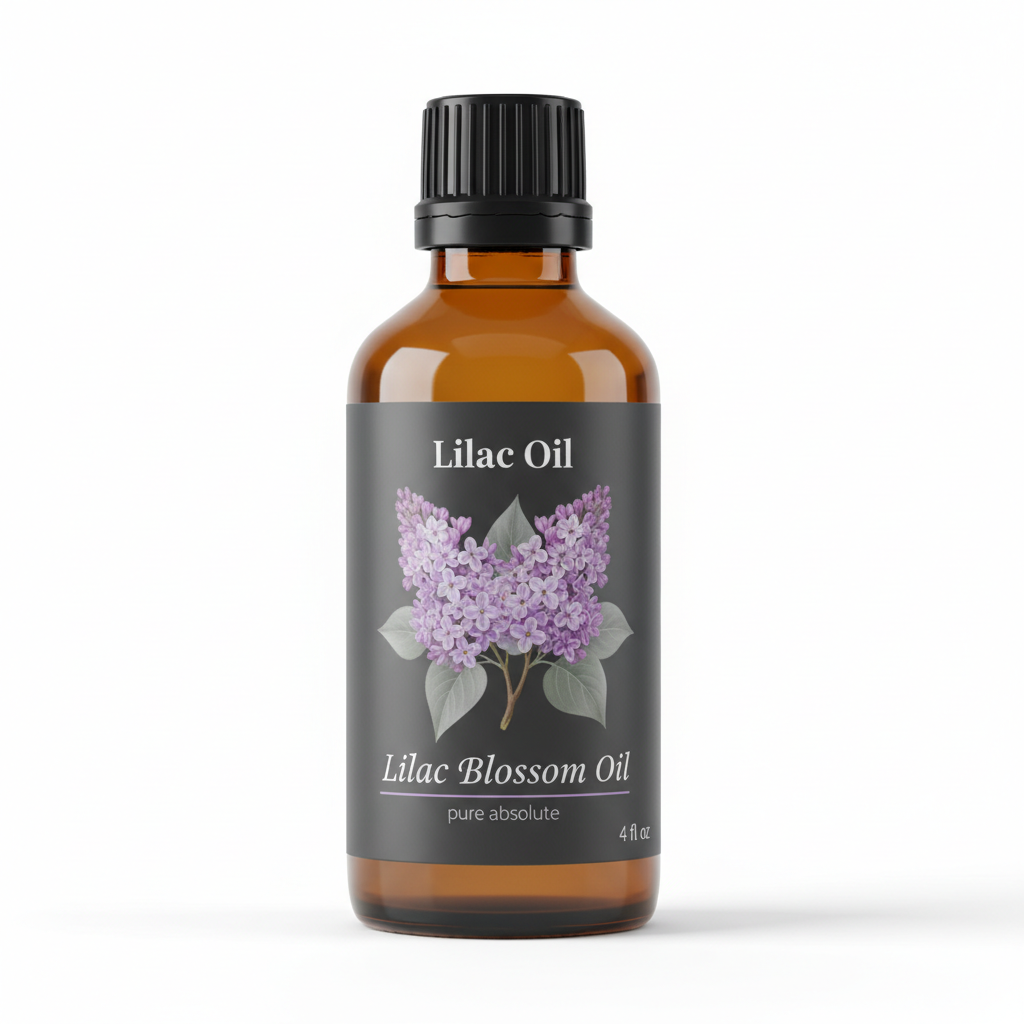
Lilac Blossom Oil
Lilac Blossom Oil from our own shop, in sizes from 0.5 oz to bulk.
From $15.99
Shop Now →Sources & Further Reading
- Koster Keunen, n.d. NF Yellow Beeswax specification. kosterkeunen.com/?p=9492
- MySkinRecipes, n.d. Solid perfume formulation and making guide. myskinrecipes.com/expert/qa
- Arquette D.J. et al., 1998. Jojoba oil and hydrogenated jojoba oil (J Cosmet Sci 49:377-383). library.scconline.org/v049n06/32
- Journal of the Society of Cosmetic Chemists, vol. 6 no. 2 (1950s volume). A classification of odours and its uses. library.scconline.org/v006n02/7