Make Lilac Scent Last Longer: More Oil Is Not the Lever
Adding more lilac oil is the least effective way to make a lilac scent last longer. A fixative is mostly a heavier, slower-evaporating material, and what sets how long a scent lasts on skin is largely the base around the oil, not how much oil you put in. The arithmetic below shows why doubling the oil buys about one extra half-life of wear, while changing the base can double the whole time.
Why a heart note fades
Our product page describes the oil as a heart (middle) note. Notes are a perfumer's shorthand for how quickly materials leave the skin: lighter, more volatile material goes first. J. Stephan Jellinek, in a talk to the New York Chapter of the Society of Cosmetic Chemists (1960), wrote that "perception of a perfume is possible only after some evaporation has taken place": a scent you can smell is a scent that is leaving. So wear time is the time it takes the molecules you can smell to run down below what your nose detects.
An older Journal of the Society of Cosmetic Chemists article, "A Classification of Odours and Its Uses" (1950s volume), compared several odorless high-boiling additives in a perfume and reported that the odor strength remaining followed the additives' vapor pressures; the author concluded that "fixatives" do have a delaying action, "but they do so at the expense of the freshness and lift" of the scent. That is the trade you make: a heavier base lengthens wear and flattens the top of the scent.
The arithmetic of "more oil"
This is a model, not a measurement, and it assumes the scent leaves skin at a steady proportional rate (first-order decay), which real fragrance does not do exactly. Let the amount of detectable scent halve every half-life. If you start at 8 times your detection threshold, you reach it after 3 half-lives. Double the oil, and you start at 16 times: 4 half-lives. That is one more half-life, a third longer, for twice the oil and twice the skin dose. Now change the base so the rate of loss halves, which is what a heavier, slower-evaporating base is meant to do. Three half-lives of the old rate become six: twice as long, at the same oil load. Reasoning from vapor-pressure principles, then, the lever is the base. We have not measured any of this on skin or fabric.
| Change | Effect in the model (start 8 times threshold) |
|---|---|
| Baseline | 3 half-lives |
| Double the oil (for example 1% to 2%) | 4 half-lives, one third longer |
| Halve the loss rate (slower base) | 6 old half-lives, twice as long |
| Both | 8 old half-lives |
For our oil the first change has a hard stop. Our skin copy tops out at 2% in a carrier, which is only the first change in the table. We publish no IFRA certificate or allergen declaration for the oil, so doubling past 2% to chase longevity is not something we recommend.
What helps, what is folklore
A "fixative" is not a magic ingredient. Jellinek cautions that a substance that works as a fixative on a paper blotter is not necessarily one on skin, in a cream or in an aerosol, and that a material should be called a fixative only in the medium where the effect has been shown. Most advice online is borrowed from the blotter.
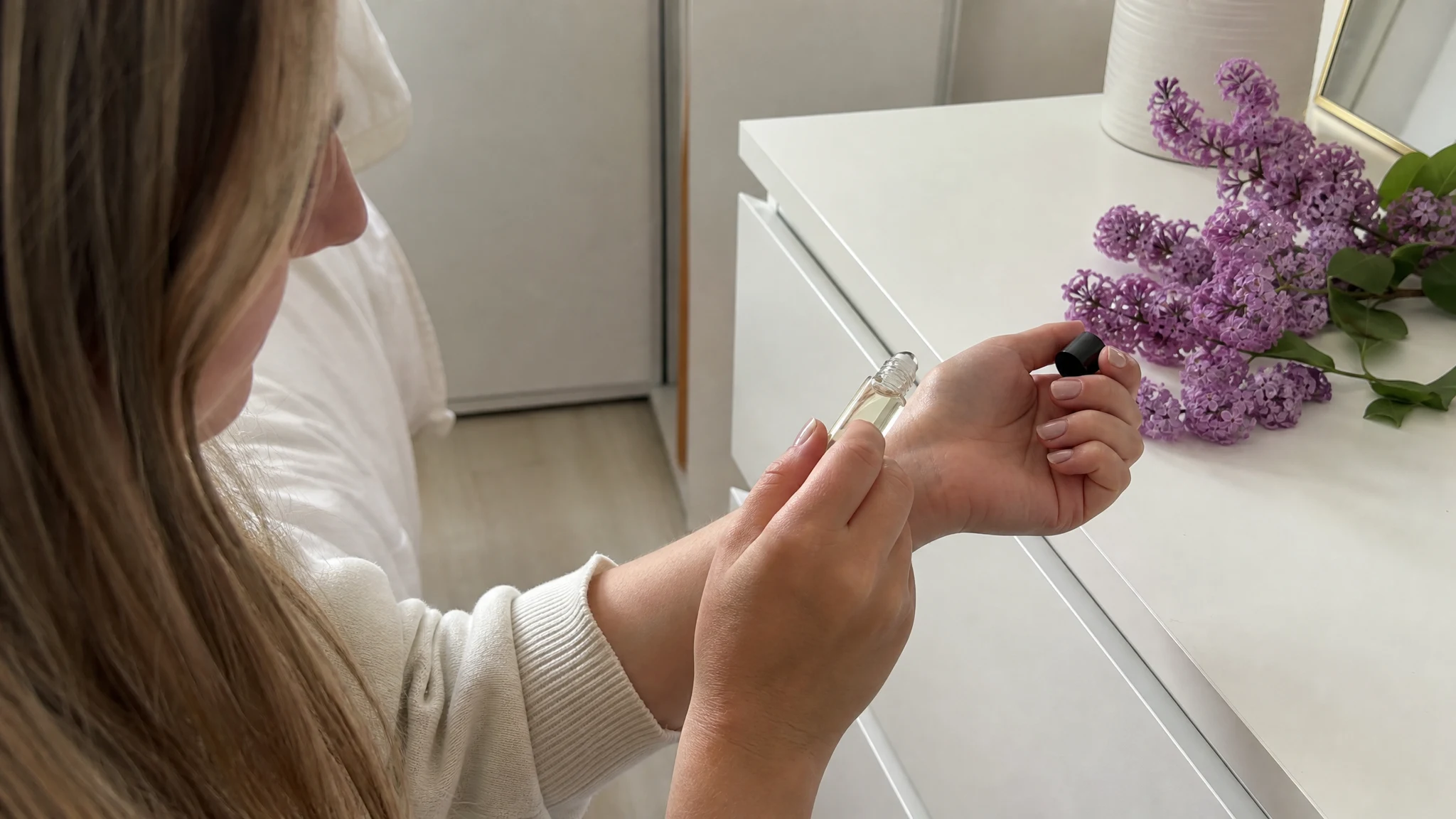
What the reasoning supports: diluting the oil in a carrier oil or a balm base, which holds components in a heavier liquid. Pair a lilac with a slower base, such as a carrier oil or wax; the solid perfume formulation is built that way and the rollerball is the liquid version. A retailer's guide, MySkinRecipes, says fragrances with strong base notes such as woods, resins or vanilla tend to last longer than light top notes, which fits the vapor-pressure argument but is the retailer's statement, not a measurement. Blending lilac with a slower partner is covered in the partners post; we sell only the lilac oil, so any such partner comes from another supplier, and a partner material has its own safety data to check.
What we could not support: that moisturized skin holds scent longer. The searches run for this article found retailer blog posts saying so, and no controlled measurement of fragrance retention by skin type or hydration. It may be true; the evidence found is anecdote. Reasoning from the base argument, an unscented lotion or oil under the scent acts as a slower base, so it is a plausible, cheap thing to try. Treat it as an untested idea.
Your nose is part of the instrument
Part of "it doesn't last" is that you stop smelling it. A review by Pellegrino and colleagues (Physiology and Behavior, 2017) reports that habituation to odors, a drop in perceived intensity with repeated exposure, is "relatively fast." In a small study (Beekman and colleagues, Foods, 2022; 19 people analyzed, perfume sprayed on an apron, not skin), odor threshold scores fell from 7.89 with no fragrance to 5.95 with 3 sprays and 3.67 with 10 sprays. The authors could not separate adaptation from masking. The practical point: ask someone else whether they can still smell it, and be careful about reapplying because you cannot. More spraying on a dulled nose means more oil on skin for no gain, and our dilution ceiling does not move because you went nose-blind.
Check the bottle before blaming the skin
If a lilac that smelled right at first now seems weaker, the oil may have changed in the bottle. Our bulk page says heat and sun "speed up drift in a composed floral scent," and advises decanting working amounts into smaller airtight bottles and keeping the main stock sealed in a cool, dark place; the stated shelf life is typically 1 to 2 years for floral oils when kept tightly capped. That is our storage copy, not a measured fade rate. The rule that follows is simple: before changing a recipe, smell the oil from the sealed bottle next to the one you have been opening. A batch made with oil that spent a summer on a sunny shelf is not a fair test of any base. See the storage article.
A routine that follows from this
- Dilute the oil in a carrier or balm base at 0.5% to 1%, patch test first, and do not go above 2%.
- Apply to clean skin, once, then leave it. Do not stack more oil to compensate.
- Ask a second person, not your own nose, whether it has faded.
- If you want longer wear, change the base (slower-evaporating carrier or wax), not the oil share, and expect a softer top.
- If you want to try an unscented moisturizer under it, patch test that combination, and know the idea is untested.
Anyone with eczema, a known fragrance allergy or reactive skin should ask a dermatologist before wearing any new scent on skin. Keep it away from eyes, children and pets. If you use it on fabric, check a hidden spot first.

Lilac Blossom Oil
Lilac Blossom Oil from our own shop, in sizes from 0.5 oz to bulk.
From $15.99
Shop Now →Sources & Further Reading
- Jellinek J.S., 1960. Evaporation and the odor quality of perfumes. J Cosmet Sci 12(3):168. library.scconline.org/v012n03/42
- Journal of the Society of Cosmetic Chemists, vol. 6 no. 2 (1950s volume). A classification of odours and its uses. library.scconline.org/v006n02/7
- Pellegrino R. et al., 2017. Habituation and adaptation to odors in humans. Physiol Behav 177:13-19. PMID 28408237
- Beekman T.L. et al., 2022. Should panelists refrain from wearing a personal fragrance prior to sensory evaluation? Foods 11(3):428. PMC8834429
- MySkinRecipes, n.d. Solid perfume formulation and making guide. myskinrecipes.com/expert/qa