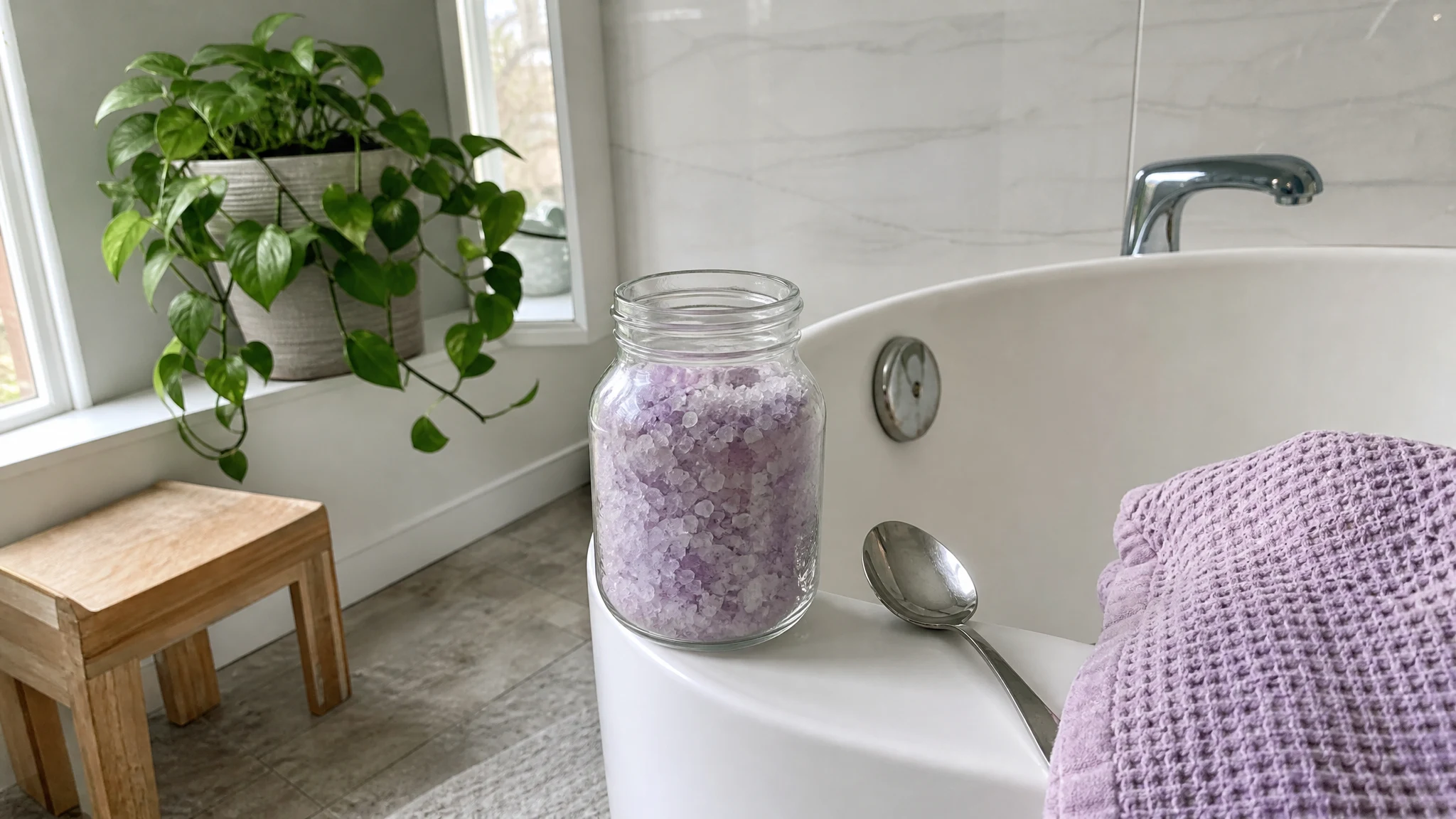
Lilac Bath Salts and Bath Bombs: Make the Salts First
If all you want is lilac scent in a bath, make salts, not bombs. Bath salts are a dry mix with one job to do, which is to get a small amount of oil spread through the tub without leaving undiluted droplets on the water surface. A bath bomb adds a chemical reaction, a binder, a mold and a drying step, and each of those is a place to lose the scent or the batch.
The physics comes first: oil floats
Oil does not dissolve in water. Drop it into a filled tub and it spreads as a film and droplets on the surface, and you sit down into it. The Tisserand Institute's bath safety page (an aromatherapy education organization, not a regulator; undated, with comments to 2019) puts it as an instruction: do not put drops of essential oil directly into a bath and then step in, because you end up in contact with undiluted oil. Its fix is to mix the oil into a vegetable oil first, or to emulsify it with an emulsifier, and it says milk and Epsom salts do not properly dissolve oils. That page is about essential oils; our oil is a composition, and we publish no data on how it disperses. The reasoning carries over, because it is about oil and water, not about the plant.
This is the reason bath recipes contain a carrier oil or a solubilizer such as polysorbate. Salt on its own is not a dispersant (Tisserand says the same of Epsom salts). Reasoning from that, oil scattered on plain salt would leave droplets of undiluted oil in the tub when the grains dissolve. The working method is therefore to put the lilac oil into the carrier oil (or solubilizer) first, then onto the salt.
Arithmetic for bath salts
Our copy says to dilute to 0.5% to 2% in a carrier oil, patch test first and start at the low end. We publish no IFRA certificate or allergen declaration, so no IFRA category limit can be calculated for the oil; the 0.5% to 2% is the only ceiling we state, and for a bath we would stay at the low end, 0.5%, calculated on the total weight of the finished mix. Using relative density 0.973 from our certificate of analysis (1 ml is about 0.973 g) and about 20 drops per ml:
| Batch | Oil at 0.5% | Oil at 1% |
|---|---|---|
| 200 g salt + 10 g carrier oil (210 g) | 1.05 g, about 22 drops | 2.1 g, about 43 drops |
| 500 g salt + 25 g carrier oil (525 g) | 2.6 g, about 54 drops | 5.25 g, about 108 drops |
Weigh the oil if you can. Method: weigh the carrier oil, add the lilac oil to it and stir, then fold that into the salt a little at a time until no wet clumps remain. The salt and the carrier are not sold by us: buy them from a soap or craft supply shop and ask for a carrier oil without a strong scent of its own.
Now the tub. Assume, as an illustration, 50 g of mix per bath and 150 liters of water. At 0.5%, 50 g of mix holds 0.25 g of oil, about 5 drops, which is about 1.7 mg per liter of bath water. On average that is very dilute. The average is not the issue: the issue is whether the oil is spread through the water or sits as droplets on top, which is why the carrier or solubilizer step matters more than the number of drops.
Bath bombs: what the reaction asks of you
A bath bomb is baking soda (sodium bicarbonate) and citric acid held together dry, with water starting the reaction that releases carbon dioxide. Scientific American's homemade bath bomb article lists two recipes, both with baking soda to citric acid at 2 to 1 by volume (2 and 2/3 tablespoons to 1 and 1/3, and 2 to 1), cornstarch as a dry filler that slows and controls the reaction, a teaspoon of vegetable oil, a few teaspoons of water added drop by drop, and 15 drops of optional fragrance. It reports that the recipe with more cornstarch fizzed less and dissolved more slowly, and that a mix that keeps puffing after mixing may be too wet.
From PubChem molar masses (citric acid, 192.12; sodium bicarbonate, 84.007) and the fact that citric acid has three acidic groups, a full reaction needs three bicarbonate units per citric acid, which is 252 g of bicarbonate to 192 g of citric acid, about 1.3 to 1 by weight. A 2 to 1 mix therefore carries more bicarbonate than the acid can use. That is our arithmetic, not a tested recommendation, and it shows why recipes differ: the ratio sets how much fizz you get and how much unreacted powder is left in the tub.
For the oil, the same rule applies as for salts, calculated on total bomb weight. In a 100 g bomb, 0.5% is 0.5 g, about 10 drops, and 1% is 1 g, about 21 drops. Do not add the oil to the water or to the damp mix on its own: water starts the reaction, and oil that is not pre-mixed into the carrier will not spread through the mix. Premix the lilac oil into the carrier oil (or the solubilizer), then add that to the dry ingredients before the water.
If you use a solubilizer
Polysorbate 20 and 80 are surfactants that let oil disperse in water. One supplier, Makesy, says a ratio of 1 to 1 (polysorbate 20 to oil) is generally enough, gives a general range of 1 to 1 up to 5 to 1 depending on the solubilizer and the oil, starts citrus oils at 3 to 1 or higher, and describes mixing the two first and checking that the blend is clear; if it turns milky, start over with more solubilizer. That is one retailer's guide to a different product from the one you might buy, and it does not address our oil. Applied to a 100 g bomb with 0.5 g of oil, a 1 to 1 ratio means 0.5 g of polysorbate and a 5 to 1 ratio means 2.5 g, or 2.5% of the bomb. Ask the supplier of your polysorbate for its recommended use level in bath products and for its documentation.
Handling: slippery tubs and who should skip this
The Tisserand page notes that fatty oils make bathing greasy, and the tub is where people fall. A CDC MMWR report (June 2011, 2008 data) estimated 234,094 nonfatal bathroom injuries among people 15 and older treated in US emergency departments, put the tub or shower at the highest rate (65.8 per 100,000) and falls behind 81.1% of injuries, with rates rising to 515.3 per 100,000 at 85 and older. Its recommendations include non-slip strips or mats and grab bars. That is general bathroom data, not data on bath oils. The practical consequence of a carrier oil in the water is a reason to rinse the tub afterward and use a mat.
Who should not use these: anyone with a skin condition or a known sensitivity to fragrance should ask a dermatologist or physician first. Keep the oil and the finished products away from eyes, children and pets, as our copy says. Do not put the oil or the mix in a child's bath. We make no claim that a lilac bath does anything for the body: it is a scent.
What we have not done
We have not made or tested bath salts or bath bombs with our oil. We do not know how well the scent holds in a dry mix, how it behaves in hot water, or whether it stains a tub. Our bulk page says to test fragrance load at a small scale before committing a batch, and that applies here: make 100 g, use it yourself once, and look for skin reaction before making more. If you sell bath products, ask us in writing for the documentation you need on the oil (none is published) and take preservation, labeling and safety substantiation to a cosmetic chemist and a regulatory consultant. For a first project that is simpler still, see the dilution chart, the skin and body products article and the gift ideas.

Lilac Blossom Oil
Lilac Blossom Oil from our own shop, in sizes from 0.5 oz to bulk.
From $15.99
Shop Now →Sources & Further Reading
- Tisserand Institute, n.d. Bath safety. tisserandinstitute.org/learn-more/bath-safety
- Scientific American, n.d. Sudsy Science: Creating Homemade Bath Bombs. scientificamerican.com/article/sudsy-science-creating-homemade-bath-bombs
- PubChem (NCBI), n.d. Molecular weight records for citric acid and sodium bicarbonate. pubchem.ncbi.nlm.nih.gov
- Makesy, n.d. How to solubilize fragrances and essential oils. makesy.com/blogs/news
- CDC, 2011. Nonfatal bathroom injuries among persons aged 15 years and older, United States, 2008. MMWR 60(22). cdc.gov/mmwr/mm6022a1