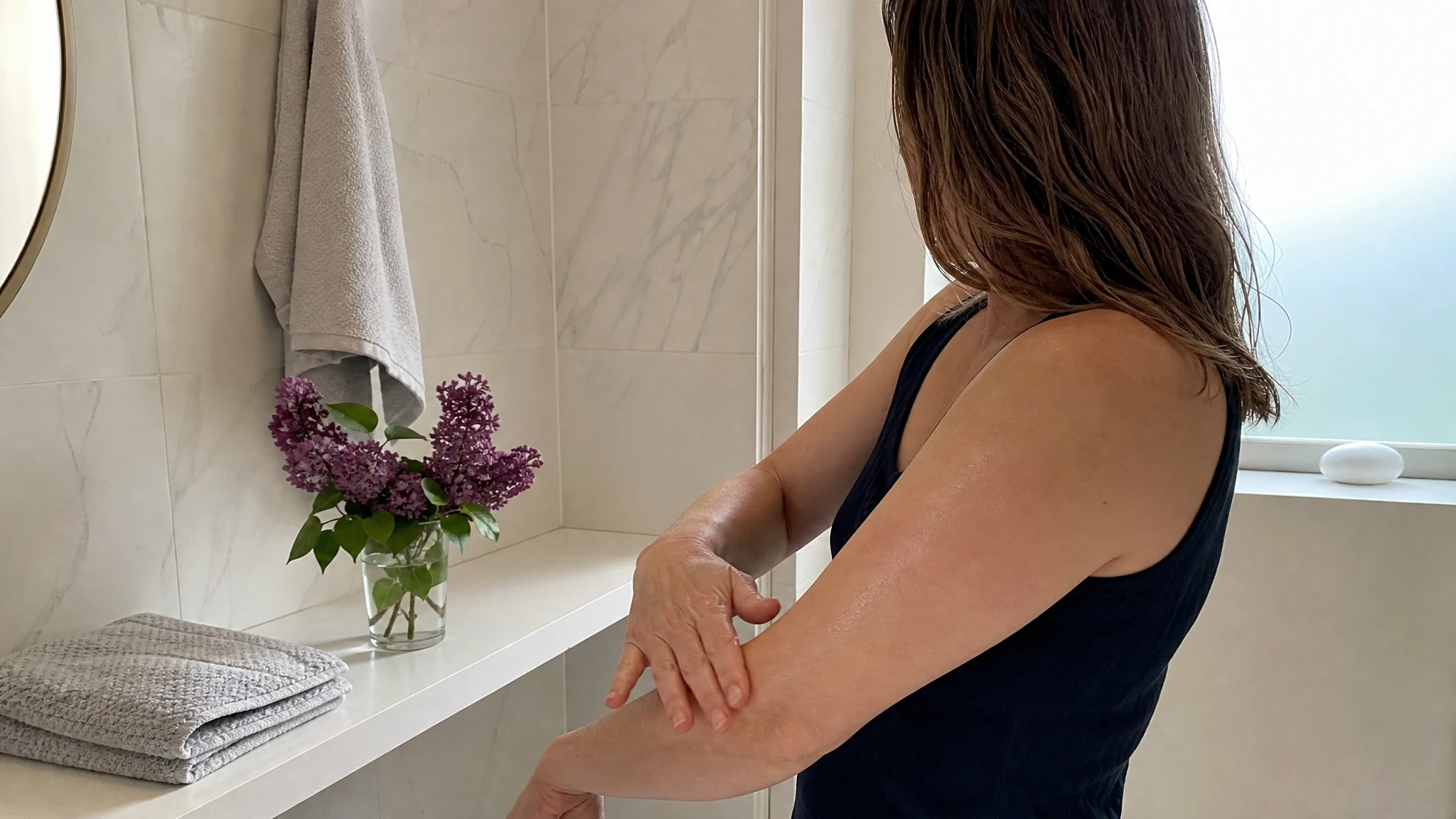
Lilac Oil in Skin and Body Products: What the Sources Say
Lilac Blossom Oil can go into a skin or body product at the one ceiling we state, 0.5% to 2% in a carrier oil, after a patch test and starting at the low end. That is the whole of our skin guidance, and this article explains why we do not offer more: the oil is a composition, the contents are not published, and every other number you will find for "skin" belongs to a different material.
What we can say, and what the paper does not show
Our pages describe the oil as a composition of botanical extracts and infused aromatics, built to be faithful to the scent of the common lilac (Syringa vulgaris). The published certificate of analysis for batch LILIBCUNINC001A lists appearance, smell, relative density (0.973 at 20 C), refractive index (1.501) and optical rotation (-0.72 degrees), with extraction method "Blended" and parts used "N/A". It is an identity and physical-properties sheet. It contains no constituent list, no allergen data, no flash point and no IFRA data. No safety data sheet, IFRA certificate or allergen declaration is published on the site. If your product will be sold, ask for what you need in writing before you order and keep the written answer. Our what's in the bottle page explains the composition and the COA is public.
Why the missing number cannot be computed from outside
The skin limits people quote come from the International Fragrance Association (IFRA). Its Guidance for the Use of IFRA Standards (51st Amendment, 2023) sorts finished products into twelve categories by how they touch the body. Fine fragrance is Category 4. Body lotion is Category 5A, face moisturizer 5B, hand cream 5C. Bar soap, shampoo, body wash and other rinse-off products are Category 9. The Standards then restrict named ingredients per category, so the limit is a property of a formula: it is worked out from what is inside the fragrance, ingredient by ingredient.
The same guidance says a Certificate of Conformity is "established by the companies creating fragrance mixtures" and that it confirms a specific mixture "up to a certain concentration" can be used in a specified product type. It also says the certificate "does not replace a safety assessment." IFRA does not issue these certificates and no IFRA certifying body exists. The consequence for this oil is plain: without a published ingredient list or a supplier certificate, nobody outside the company can compute a Category 4, 5A or 9 limit for it, and we do not print one. A "higher for rinse-off" number is exactly what a Category 9 certificate would give, and we have no such certificate to cite. For the arithmetic of 0.5%, 1% and 2% at common batch sizes, see the dilution chart.
The documented risk is allergy, and the dose is not the whole story
DermNet's article on fragrance allergy (July 2020) says it is believed to affect around 1% of adults and about 1.8% of children and adolescents, ranks second only to nickel as a cause of allergic contact dermatitis, and finds an allergy in around 10% of people who are patch tested. Its 2023 article on cosmetics allergy says fragrances are the most common source of contact dermatitis from cosmetics, and that irritant reactions account for 80% of contact dermatitis. Those are population figures for fragrance in general, not findings about lilac or about our oil.
A rash from a fragrance allergy is not immediate. DermNet puts an allergic rash at more than 12 hours after exposure, peaking around 48 hours. Contact urticaria, a different reaction, shows within minutes to an hour. That timing is why a patch test has to be watched for days, not minutes.
The labelling arithmetic shows how little it takes
The European Commission's page on fragrance allergen labelling says Regulation (EU) 2023/1545 adds individual labelling for 56 further allergens, required above 0.001% in leave-on products and 0.01% in rinse-off products. These are labelling triggers, not safe levels, and they apply to the EU market. They still show the scale. If you dose an oil at 1% into a lotion, a single allergen that makes up only 0.1% of the oil (0.001 divided by 1) is already at the leave-on trigger. At 2% in a rinse-off soap, the same trigger is 0.5% of the oil (0.01 divided by 2). Whether any of this applies to our composition is unknown, because the contents are not published. That is the case for asking in writing.
A patch test, done the way the sources describe
DermNet advises testing a new cosmetic by placing a small sample on the inner wrist or elbow and watching the site for 24 to 48 hours. The American Academy of Dermatology describes clinic patch testing as patches left on for 48 hours and a return visit "after 4 to 7 days", and says a first round can miss the cause. Reasoning from those two descriptions, a home test is a screen for an obvious reaction, not a clearance: it can miss a delayed reaction. A practical version is to test the finished, diluted product (not the neat oil), on a small area, with the product at the strength you plan to use, and keep watching for a week.
Neat oil is outside our copy. Our guidance is dilute to 0.5% to 2%, keep it away from eyes, children and pets, and use externally only. It is not for internal use. For a child, a pregnant person, anyone with eczema or a known fragrance allergy, or anyone on a dermatologist's care, the right person to ask is a physician or dermatologist, not us.
Describe it as scent
The FDA's page Is It a Cosmetic, a Drug, or Both? (Or Is It Soap?) says intended use decides the category, and that a fragrance with "aromatherapy" claims such as helping a consumer sleep "meets the definition of a drug because of its intended use." It adds that claims on a website or other promotional material can do the same. Our own pages say the oil's purpose is scent and make no medical claims. A body oil or lotion you sell should be described the same way.
If you sell what you make
FDA's fact sheet on homemade cosmetics says making cosmetics at home is not against the law, that the firm named on the label "is required to ensure adequate substantiation of safety," and that a website address is not an adequate label address. FDA's fragrance page says fragrance ingredients must meet the same safety requirement as other cosmetic ingredients and need no FDA approval, and that a label may list "Fragrance" without naming components. That page also says FDA lacks the authority to require allergen labelling, while FDA's MoCRA page says the 2022 law requires FDA to set fragrance allergen labelling rules and requires responsible persons to report serious adverse events within 15 business days. The two FDA pages read differently, and no final allergen rule turned up in the sources read for this article. Whether MoCRA's small-business exemption (from GMP, registration and listing) covers you is a question for a product-safety or regulatory attorney. A cosmetic chemist can assess the formula.
Where the oil is not the answer
We sell one material. The carrier oil, lotion base, preservative, emulsifier and bath or soap base are partner materials from a craft or soap supply shop. A water-containing product such as a lotion needs a preservative system chosen by the supplier or a chemist; the oil does nothing for that. For product walk-throughs see the body oil, lotion, cold process soap and melt and pour soap. None of the recipes in this series has been made or tested by us, and no cosmetic chemist or dermatologist has reviewed this article.
For a first trial, the shop page lists the smaller sizes, and the chart turns a batch size into grams.
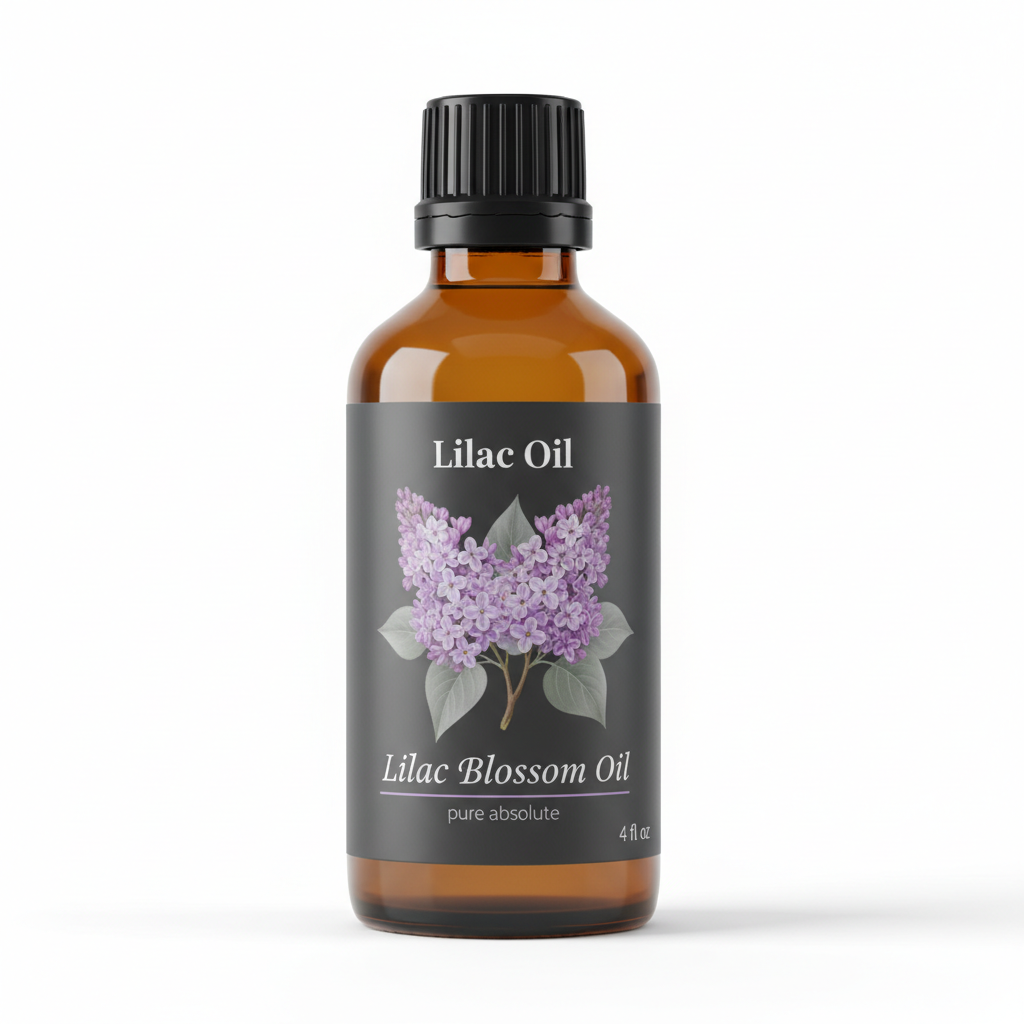
Lilac Blossom Oil
Lilac Blossom Oil from our own shop, in sizes from 0.5 oz to bulk.
From $15.99
Shop Now →Sources & Further Reading
- IFRA, 2023. Guidance for the Use of IFRA Standards, 51st Amendment. ifrafragrance.org
- DermNet, 2020. Fragrance allergy. dermnetnz.org/topics/fragrance-allergy
- DermNet, 2023. Cosmetics allergy. dermnetnz.org/topics/contact-reactions-to-cosmetics
- American Academy of Dermatology. Patch testing can find what's causing your rash. aad.org
- European Commission. Fragrance allergens labelling (Regulation (EU) 2023/1545). single-market-economy.ec.europa.eu
- FDA. Is It a Cosmetic, a Drug, or Both? (Or Is It Soap?). fda.gov
- FDA. Small Businesses and Homemade Cosmetics: Fact Sheet. fda.gov
- FDA. Fragrances in Cosmetics. fda.gov
- FDA. Modernization of Cosmetics Regulation Act of 2022 (MoCRA). fda.gov