DIY Lilac Lotion: Scent a Preserved Base, Do Not Build One
The scent is the easy part of a lilac lotion. The hazard is the water: a lotion is mostly water, and a water-based product with no working preservative is a place for bacteria and mold to grow. This article takes a position that some recipe pages avoid: if you are new to this, buy a preserved, unscented lotion base from a cosmetic supply shop and scent it, rather than building an emulsion from scratch.
Why the base matters more than the oil
The FDA's page on microbiological safety and cosmetics (content current as of 10/15/2024) says cosmetics can become harmful if contaminated with pathogenic bacteria or fungi, lists an "ineffective preservation system" and "contaminated raw materials, water, or other ingredients" among the causes, and states that microbial contamination is a common reason for cosmetic recalls. It also warns that adding water to a product "waters down preservatives." That last point applies directly to a DIY lotion: stretching a base with extra water, or with an aloe or hydrosol you did not preserve, lowers the preservative's concentration below what the base maker set.
The same page makes the maker responsible. Nothing in it tells a home maker how to confirm that a homemade emulsion is preserved well enough. The FDA's MoCRA page (current as of 08/10/2026) says federal law and FDA rules do not prescribe particular safety tests, which means a challenge test (a lab procedure that checks whether a preservative system holds up) is something you would commission, not something the rules hand you.
So the recommendation, as a stated position: start from a base whose maker has already preserved it and says it is unscented, and do not add water, hydrosols, fresh botanicals or extra water-based ingredients to it.
What a preservative data sheet looks like
You will meet the numbers if you read a base's ingredient list or consider adding a preservative yourself. One supplier page, Inolex's Lexgard PE9010 (phenoxyethanol and ethylhexylglycerin), gives a use level of 0.5% to 1.0% w/w, a pH range of 3 to 12, and instructions to add it to the water phase below 80 C or during cool-down at about 40 C. It lists emulsions, creams and lotions among the applications. That is one product's data sheet. Another preservative will have a different use level, pH window and temperature limit, and the numbers belong to that product, not to preservatives in general.
The arithmetic matters because a preservative is dosed by weight of the whole batch. In 250 g of lotion, 1.0% is 2.5 g. A drop-based measure is not good enough at that scale. This is also why we do not give a from-scratch emulsion recipe here: an emulsion needs the right emulsifier, oil phase, water phase, preservative and pH, and the person to ask is a cosmetic chemist or a cosmetic-chemistry textbook, not a scenting article. We have not made a lotion from scratch and will not pretend a recipe is validated.
Scenting a base: the arithmetic
Our own safety copy for skin use is to dilute to 0.5% to 2% in a carrier oil, patch test on a small area first, and start at the low end. We publish no IFRA certificate or allergen declaration for the oil, so no IFRA category limit can be calculated for it, and the 0.5% to 2% figure is the only ceiling we state. For a leave-on lotion we would start at 0.5% to 1%. Using the figures from our certificate of analysis (relative density 0.973, so 1 ml is about 0.973 g) and about 20 drops per ml:
| Oil share | In 100 g of base | In 250 g of base |
|---|---|---|
| 0.5% | 0.5 g, about 10 drops | 1.25 g, about 26 drops |
| 1% | 1 g, about 21 drops | 2.5 g, about 51 drops |
| 2% | 2 g, about 41 drops | 5 g, about 103 drops |
Droppers vary and a thick oil drops differently, so weigh the oil on a 0.01 g scale instead of counting. At 100 g and 0.5%, a miscount of two drops is a 20% error in dose. Weigh the base into a clean container, add the weighed oil, and stir until the mixture looks uniform. Use clean, dry tools: the FDA page names contaminated ingredients as a route in.
One thing to check before you pour: whether the base maker states a limit for added fragrance (it may). If it does, the lower of the base maker's limit and our 0.5% to 2% is your ceiling.
Who the oil is not the answer for
Fragrance is one of the better-documented causes of contact allergy. In a review by Uter (Allergol Select, 2017, reprinting a 2013 article), fragrance sensitization in the general population was put at 1% to 3%, and positive reactions to fragrance mix I ran from 4.5% to 14.8% across European studies of patients sent for patch testing. Those figures describe the standard fragrance-mix allergens, not our oil, whose contents we do not publish. What they show is that a leave-on product is not a neutral place to try an undeclared fragrance. If you have eczema, a known fragrance allergy, or reactive skin, ask a dermatologist before using any scented leave-on, and keep the lotion away from eyes, children and pets, as our copy says.
A patch test of your finished lotion, not just the oil, is the minimum. Ask your dermatologist or the base maker how long to wait and where to apply it.
If you plan to sell it
Everything above is for a lotion you make for yourself. A lotion sold to others is a different job. The FDA's MoCRA page says the responsible person must maintain records supporting adequate safety substantiation, must report serious adverse events within 15 business days, and that certain small businesses are exempt from registration and listing, but the exemption does not cover every product type. For a product sold to the public, ask us in writing for the documents you need on the oil (none is published on the site) and get the answer in writing, then work with a cosmetic chemist and a regulatory consultant or product-safety attorney on stability testing, preservation testing and labeling.
What we have not done
We have not made, tested or stability-checked a lilac lotion. We do not know how the oil behaves in your base: whether it separates, discolors or fades, or how long the scent lasts. The calculation above is arithmetic from our certificate of analysis and our own copy, nothing more. Make a small batch of 100 g, keep a sample of the unscented base for comparison, and look for changes before you scale up. Our oil is a composition built to be faithful to the scent of the common lilac, sold neat, and we sell only the oil: the lotion base, containers and any preservative come from a cosmetic or soap supply shop.
If you would rather have an oil-based product with no water in it, the after-shower body oil is simpler to make and has no water to preserve. See the lilac body oil post, the dilution chart and the skin and body products article.
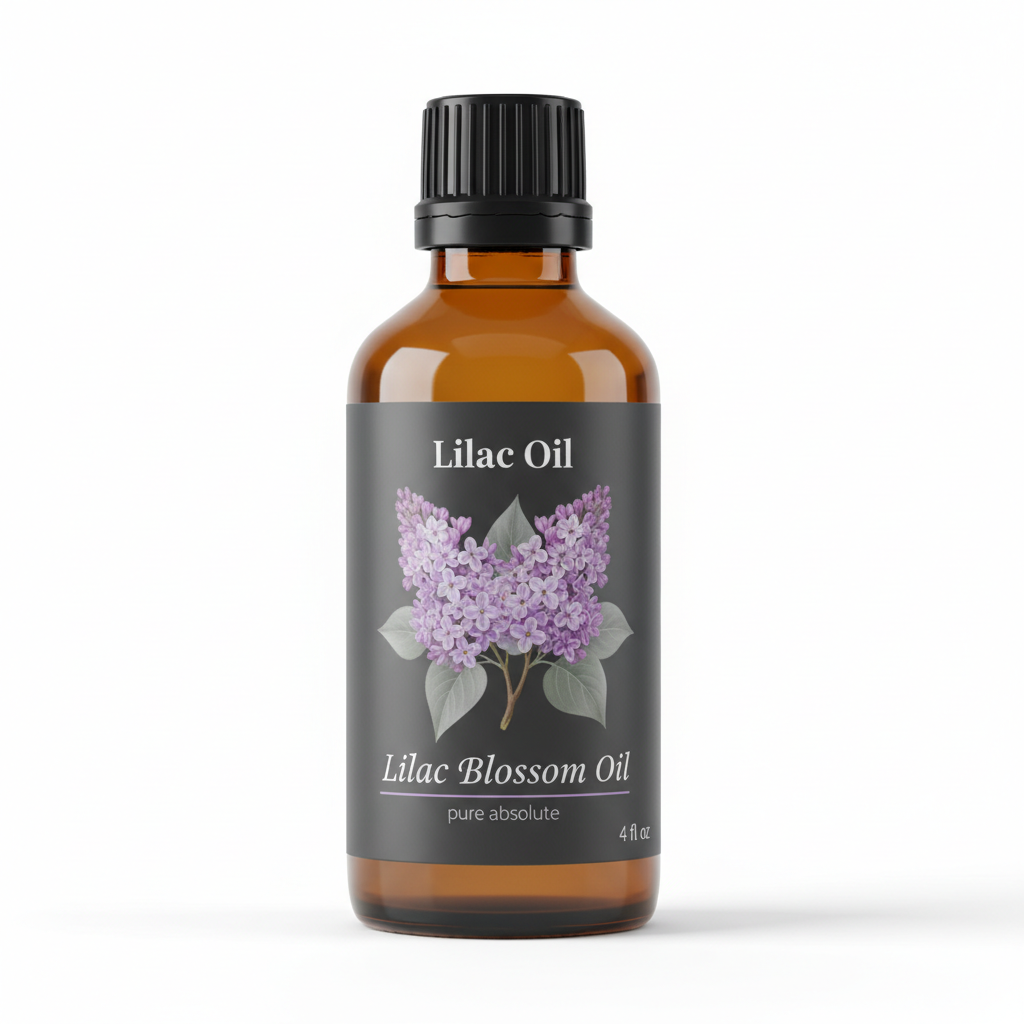
Lilac Blossom Oil
Lilac Blossom Oil from our own shop, in sizes from 0.5 oz to bulk.
From $15.99
Shop Now →Sources & Further Reading
- FDA, 2024. Microbiological Safety and Cosmetics. fda.gov/cosmetics/potential-contaminants-cosmetics
- FDA, 2026. Modernization of Cosmetics Regulation Act of 2022 (MoCRA). fda.gov/cosmetics/cosmetics-laws-regulations
- Inolex, n.d. Lexgard PE9010 product page. inolex.com/products/lexgard-pe9010
- Uter W., 2017. Contact allergy to fragrances: current clinical and regulatory trends. Allergol Select 1(2):190-199. pmc.ncbi.nlm.nih.gov/articles/PMC6040011