Lilac Cold Process Soap: A Worked Test Batch, Lye First
Make a 500 g test batch of lilac cold process soap before you commit a full pour, and keep the oil at 2% of the batch weight or lower for that first batch. A floral composition's behaviour in raw soap batter, whether it speeds trace, browns or fades, cannot be read off a label, and our own certificate of analysis does not address it.
Lye comes before the recipe
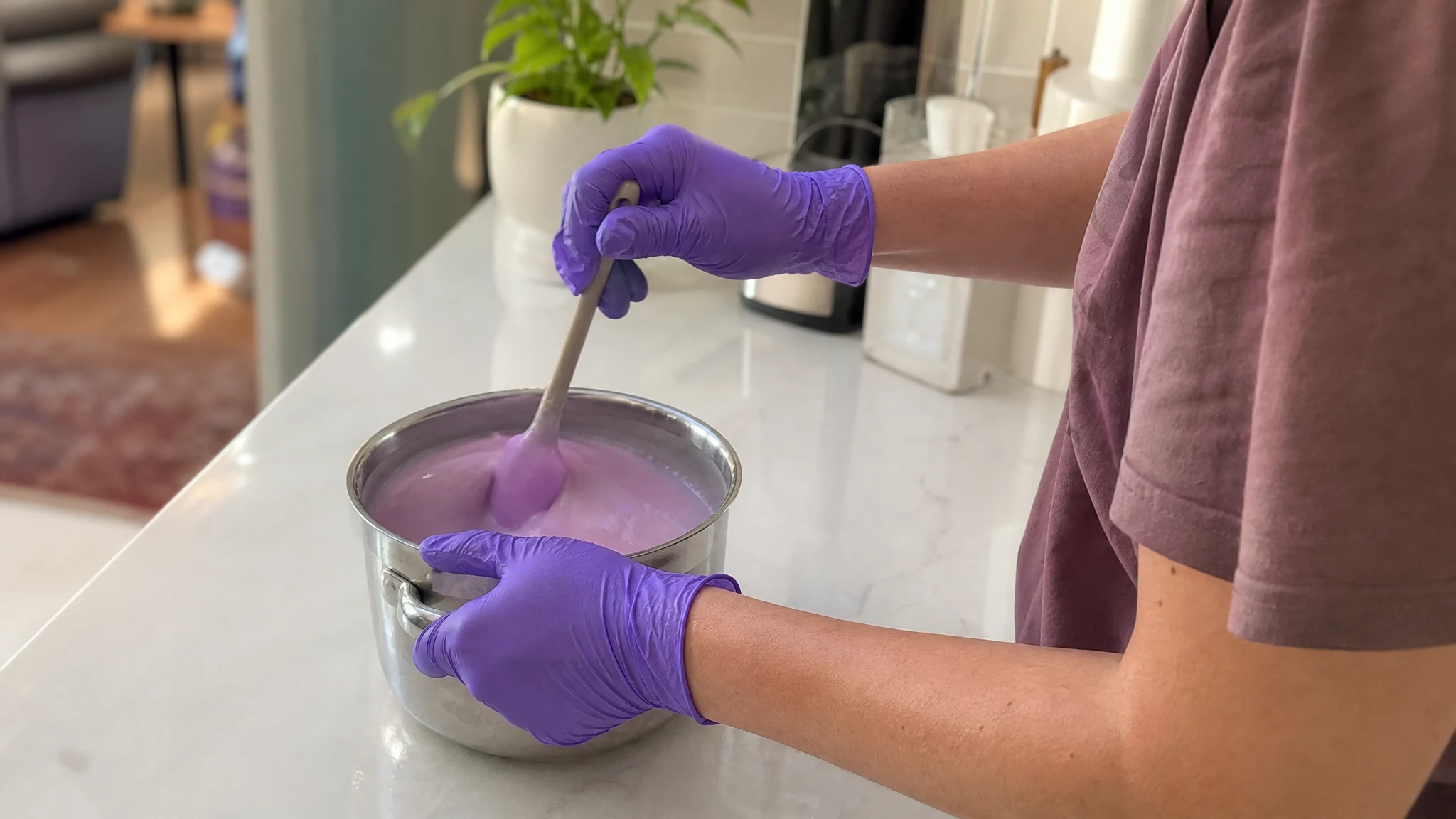
Cold process soap is made with sodium hydroxide, and the hazard is the reason to read this section first. The CDC's NIOSH Pocket Guide entry for sodium hydroxide lists exposure by inhalation, ingestion, skin and eye contact, with symptoms that include eye and skin burns. It says to prevent skin and eye contact, to flush skin with water immediately, to irrigate the eyes immediately, and to provide an eyewash station and quick-drench shower where it is handled. A lye supplier's instructions add the order of mixing: "always add the lye to the water; never add water to the lye" (Certified Lye). Wear eye protection and gloves, work where children and pets cannot walk in, and call a poison control centre or a physician for a splash that water does not resolve. This article is not a substitute for a soap-making class.
The formulation
This is a formulation worked out from published figures and arithmetic. We have not made it, and no soap maker, chemist or dermatologist has reviewed it. Lye is calculated as oil weight times each oil's saponification (SAP) value. Certified Lye's chart gives averages of 0.1353 for olive oil and 0.1910 for refined coconut oil (76 degree), and tells buyers to ask a supplier for the exact value for a specific oil. Its method is: lye = oil weight times SAP value, lye solution = lye divided by 0.3 (a 30% lye solution), water = solution minus lye. The 5% lye discount below is our assumption, a choice that leaves some oil unsaponified, not a figure from that source.
| Ingredient | Working | Weight |
|---|---|---|
| Olive oil | 70% of oils | 350.0 g |
| Coconut oil (76 degree) | 30% of oils | 150.0 g |
| Lye at 0% discount | 350 x 0.1353 + 150 x 0.1910 = 47.36 + 28.65 | 76.0 g |
| Lye at 5% discount | 76.0 x 0.95 | 72.2 g |
| Lye solution (30%) | 72.2 / 0.3 | 240.7 g |
| Water | 240.7 - 72.2 | 168.5 g |
| Batch before fragrance | 500 + 240.7 | 740.7 g |
Oils, lye and water are partner materials from a soap supply shop, not something we sell; we sell only the lilac oil. Weigh everything on one scale in grams. Use your own soap calculator to confirm these numbers against the SAP values your oil supplier gives, and do not scale the lye by eye.
How much lilac oil, and why the ceiling is 2%
Our own skin copy is 0.5% to 2% in a carrier, with a patch test and the low end first. We state no figure for soap. For a rinse-off product the International Fragrance Association (IFRA) puts bar soap in Category 9 of its Guidance for the Use of IFRA Standards (51st Amendment, 2023), and a limit in that category is calculated for a specific fragrance by whoever holds its formula. Our oil is a composition with undisclosed contents and no published IFRA certificate or allergen declaration, so no Category 9 limit can be calculated for it outside the company. We therefore reuse our only stated figure, 2%, as the ceiling for a first batch. That is a conservative placeholder, not a clearance.
| Oil as % of batch | Grams on the 740.7 g batch | About how many drops |
|---|---|---|
| 0.5% | 3.7 g | 76 |
| 1% | 7.4 g | 152 |
| 2% | 14.8 g | 305 |
Drops assume about 20 per ml and 0.973 g per ml from the COA, so weigh the oil instead. A 0.5 oz bottle holds about 14.4 g, which is 1.9% of this batch. For comparison, a soap-maker's blog post (Soap Queen, Bramble Berry's blog, undated page) gives a general medium-strength rate of 0.7 ounces per pound of cold process batter. On this batch that is about 32 g, or 4.4%, more than twice our ceiling. That rate is general guidance for fragrance and essential oils as a class, it comes from a different seller, and it is not a limit for our oil. Our bulk page says only that the oil has "decent throw" in cold process soap and reads softer than musks or woods, and tells you to test at small scale. That is the shop's statement, not a test result, and no test of this oil in soap has been published. Expect that a 2% ceiling may give a quiet soap, which is a trade-off for you to weigh against asking for documentation and going higher.
What can go wrong in the pot
Acceleration. Wholesale Supplies Plus (December 2025) says acceleration "happens when a fragrance speeds up trace, sometimes within seconds of stirring it in," attributes it to compounds reacting with the heat and high pH of raw batter, and suggests cooler batter, hand stirring in place of a stick blender after the fragrance goes in, a water discount, and adding the fragrance in two parts and evaluating after the first. Whether our oil accelerates is not documented anywhere, so the cautious order is to add a small portion first, stir by hand, and see. If it thickens fast, pour at once.
Browning. The same supplier's article on vanillin says vanillin browns on exposure to air and light, and that discoloration increases as pH becomes more alkaline, so cold process soap can brown "almost overnight." Soap Queen's page says the cause is mainly vanillin but that other aroma chemicals may discolour as well, and that a vanilla stabilizer gave inconsistent results in cold process. Neither source addresses floral oils specifically, and our oil's contents are not published, so we cannot say whether it contains vanillin. Ask in writing, and judge the colour of a bar after several days, not hours.
Fading. None of the sources read for this article covers how a lilac-type composition survives saponification and cure. Reasoning from the shop's own note that florals read softer than heavier notes, the practical consequence is that a floral may be quieter than you expect after cure. It is a reason to make the test bar first.
If you sell the soap
The FDA's page Is It a Cosmetic, a Drug, or Both? (Or Is It Soap?) says a product is soap under 21 CFR 701.20 only if the bulk of its nonvolatile matter is an alkali salt of fatty acids, the detergent action comes from those compounds, and it is labelled, sold and represented solely as soap. Soap that meets the definition is regulated by the Consumer Product Safety Commission. Claims on labels or websites can change the category, and the FDA says a fragrance sold with aromatherapy claims, such as helping a consumer sleep, meets the definition of a drug. Our oil's purpose is scent, and a soap should be described the same way. Whether your product qualifies, how to label it and what safety substantiation it needs is a question for a product-safety attorney, and a cosmetic chemist can assess the formula. The supplier's documentation for the oil is part of that file, so ask for it in writing before you order. Related reading: skin and body products, the dilution chart and melt and pour soap, which skips lye altogether.
The oil comes in nine sizes from 0.5 oz up; see the shop page for the current price per size, and start with the smallest that covers a test batch.

Lilac Blossom Oil
Lilac Blossom Oil from our own shop, in sizes from 0.5 oz to bulk.
From $15.99
Shop Now →Sources & Further Reading
- CDC/NIOSH. NIOSH Pocket Guide to Chemical Hazards: Sodium hydroxide. cdc.gov/niosh/npg/npgd0565
- Certified Lye. Lye soap: SAP values and calculation method. certified-lye.com
- IFRA, 2023. Guidance for the Use of IFRA Standards, 51st Amendment. ifrafragrance.org
- Soap Queen (Bramble Berry), n.d. How to use the fragrance calculator. soapqueen.com
- Wholesale Supplies Plus, 2025. Using Fragrance in Cold Process Soap. wholesalesuppliesplus.com
- Wholesale Supplies Plus. Understanding the vanillin villain. wholesalesuppliesplus.com
- Soap Queen (Bramble Berry). Vanillin discoloration in cold process soap. soapqueen.com/?p=72429
- FDA. Is It a Cosmetic, a Drug, or Both? (Or Is It Soap?). fda.gov