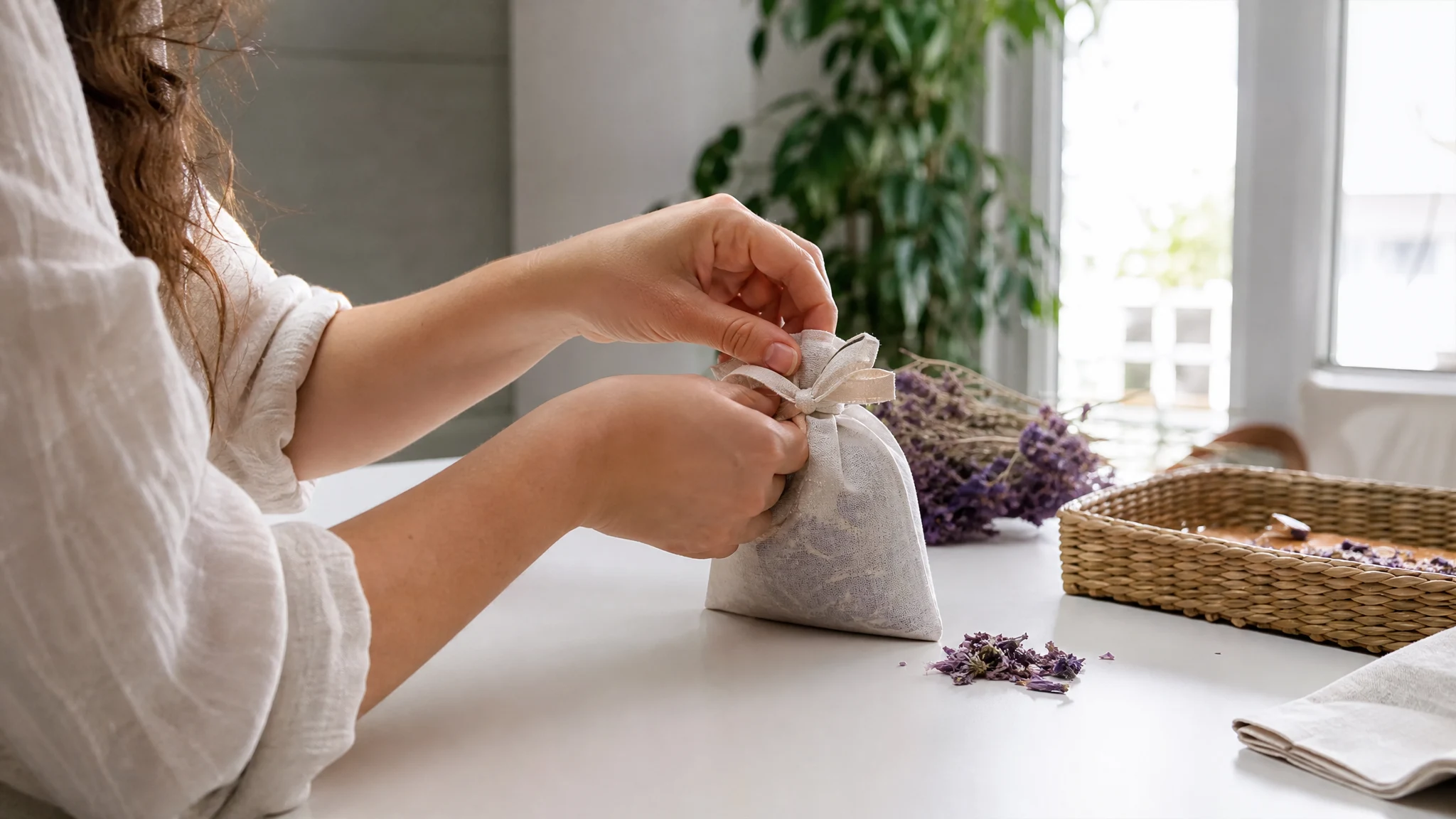
Lilac Sachets and Potpourri: Oil on the Fixative, Not Cloth
The oil goes on the fixative, never on the fabric and never straight onto the dried material. That one order of operations is the whole recipe: dried base, a fixative that holds the scent, a few drops of Lilac Blossom Oil worked into the fixative, then weeks in a sealed jar. The numbers below come from three university extension recipes and our own arithmetic. We have not made or tested a lilac sachet, so treat it as a formulation to try on a small batch.
Start with the dried base, and do not expect it to smell like lilac
You supply the dried material: leaves, petals, bark, spice, whatever you have, from a garden, a craft shop or a grocer. We sell only the lilac oil. Lilac blossoms themselves are a poor choice as the scent source. A 2016 study in the Journal of Forestry Research analysed floral volatiles from nine Syringa species and varieties by headspace sampling and GC-MS (Yang et al., 2016). In detached flowers of S. vulgaris 'President Lincoln' left to dry naturally, alcohols were released in the greatest amount, and 2-ethyl-1-hexanol made up about 40 percent of the total. The study did not compare that to the fresh bloom's smell by panel, so it does not say what a person would notice, but it does say the emission changes in character as the flower dries. Dried lilac is for colour and texture. The scent comes from the oil.
Whatever the base, it has to be fully dry. Nebraska Extension says the plant materials must be thoroughly dried so the mixture does not mold (Frogge, Nebraska Extension, 2021). If a petal bends instead of snapping, it is not dry enough.
The fixative: what it does and how much
A fixative is a porous, slow-releasing material that the oil soaks into. Orris root is named as the best-known one by Nebraska Extension, which adds that chunks last longer and suit sachets, while powder is more common. Three extension sources give different amounts:
| Source | Fixative | Oil | Cure |
|---|---|---|---|
| University of Georgia Extension Bulletin 1170 (first published 2008, revised 2025) | 1 oz for a recipe of 1 quart dried leaves plus 1 quart dried flowers | 5 to 10 drops of essential oil, added to the fixative first | about 2 months |
| Iowa State University Extension | 1 oz for every 4 to 6 cups of dried petals and leaves | no amount given | 4 to 5 weeks |
| Nebraska Extension (2021) | amount not given | "a few drops of a compatible essential oil" | at least a month |
The Georgia and Iowa fixative rates are close: 1 oz per 2 quarts (8 cups) versus 1 oz per 4 to 6 cups. Georgia's is the lighter. Sources: UGA, 2008, rev. 2025 and Iowa State University Extension. All three describe an essential oil, not a composed oil. Applying the figure to ours is our inference.
Oil by weight: what 5 to 10 drops is
Drops are a poor unit, so convert. For the batch of the oil on our COA, relative density is 0.973, so 1 ml is about 0.973 g; at about 20 drops per ml (droppers differ; weigh if you can), 5 drops is 0.25 ml or about 0.24 g, and 10 drops is 0.5 ml or about 0.49 g. The Georgia batch is 2 quarts (about 1.9 litres) of dried material plus 1 oz (28.35 g) of fixative. So 0.24 to 0.49 g of oil on 28.35 g of fixative is about 0.9 to 1.7 percent by weight. That sits inside the 0.5 to 2 percent in our own skin copy, which is for a carrier oil on skin and is not a potpourri figure, so we note the overlap and nothing more. A 0.5 oz bottle holds about 14.4 g, roughly 296 drops: enough for dozens of batches at this scale. Oil is not what limits you here. The dried base and the fixative are.
Lilac is a heart note in our product copy, and the bulk page says florals read softer than musks or woods. Expect a quiet sachet. Do not respond by doubling the oil in the first batch. Nebraska's advice for a weak result is to drop extra oil onto a little fixative, then fold that in, rather than onto the mix. Do that after the cure, when you can smell what you actually have.
The method, in order
- Put 1 oz (about 28 g) of orris root, powder or chunks, in a glass or ceramic bowl.
- Weigh 0.25 g of oil (about 5 drops) onto it and stir. Georgia's instruction is to add the oil to the fixative before combining.
- Add 2 quarts of fully dried material and mix. Nebraska recommends a glass or ceramic bowl.
- Seal it in a glass jar (a pint or quart canning jar) because, per Nebraska, plastic or metal may interact with essential oils. Keep it out of heat and sunlight, and shake it daily.
- Wait at least four weeks. The extension sources run from 4 to 5 weeks to 2 months; longer does no harm, per Nebraska.
- Smell it. If it is faint, add up to another 5 drops to a spoonful of fresh fixative, fold it in, and give it another week.
The sachet bag and the stain problem
Fill the bag with the cured mix, not with oil. Plain loosely woven cotton or muslin, or a paper-lined bag, lets scent out and keeps the dried material in. Never put drops directly on the cloth. We found no conservation-literature source on how essential oil marks cloth, so this is reasoning rather than a sourced rule: an oil is not a water-based scent, it cannot be rinsed out the same way, and a stain from it can show as a darker patch on pale fabric. Test your bag fabric with one drop in an unseen corner and let it sit a week before you trust it. Put the sachet in a drawer or closet, not in a pillowcase or a bed, where it would be in sustained contact with skin and hair; our own copy limits skin use to dilutions of 0.5 to 2 percent in a carrier oil, and a sachet is not that.
Children, pets, and what we do not know
Our safety copy says to keep the oil away from children and pets, and a sachet is an easy thing to swallow or chew. The pet-specific source we found concerns liquid potpourri: Pet Poison Helpline says ingestion can cause chemical burns to lips, tongue, gums and throat, and that cats are particularly sensitive (Pet Poison Helpline). That page does not address dried potpourri or essential oils, so it does not tell you about this recipe. Ask a veterinarian before using any scented sachet where a cat or dog can reach, and see our pet article. For a child who has eaten one, call Poison Control or a physician.
The site publishes no safety data sheet, allergen declaration or IFRA certificate for the oil. If the sachets are for sale, or for guests (see lilac wedding favors), ask in writing before ordering and get the answer in writing. For other ways to scent a drawer or a room, see the uses article, the linen spray recipe and the gifts roundup; to keep the leftover oil from drifting, see how to store it. The COA for the batch we publish shows density, refractive index and optical rotation, and no ingredient data.
Mix one small trial batch, wait the month, and judge it by smell before you scale it.

Lilac Blossom Oil
Lilac Blossom Oil from our own shop, in sizes from 0.5 oz to bulk.
From $15.99
Shop Now →Sources & Further Reading
- Yang X, Zhao J, Zheng J, et al., 2016. Analysis of floral scent emitted from Syringa plants. J Forestry Res 27(2):273-281. doi 10.1007/s11676-015-0156-3
- Frogge MJ, Nebraska Extension in Lancaster County, 2021. Potpourri: make your own. lancaster.unl.edu
- University of Georgia Extension, 2008 (rev. 2025). Bulletin 1170, Herbs in Southern Gardens. fieldreport.caes.uga.edu/B1170
- Iowa State University Extension. Growing, harvesting, and drying herbs. yardandgarden.extension.iastate.edu
- Pet Poison Helpline. Liquid potpourri. petpoisonhelpline.com/poison/potpourri-liquid