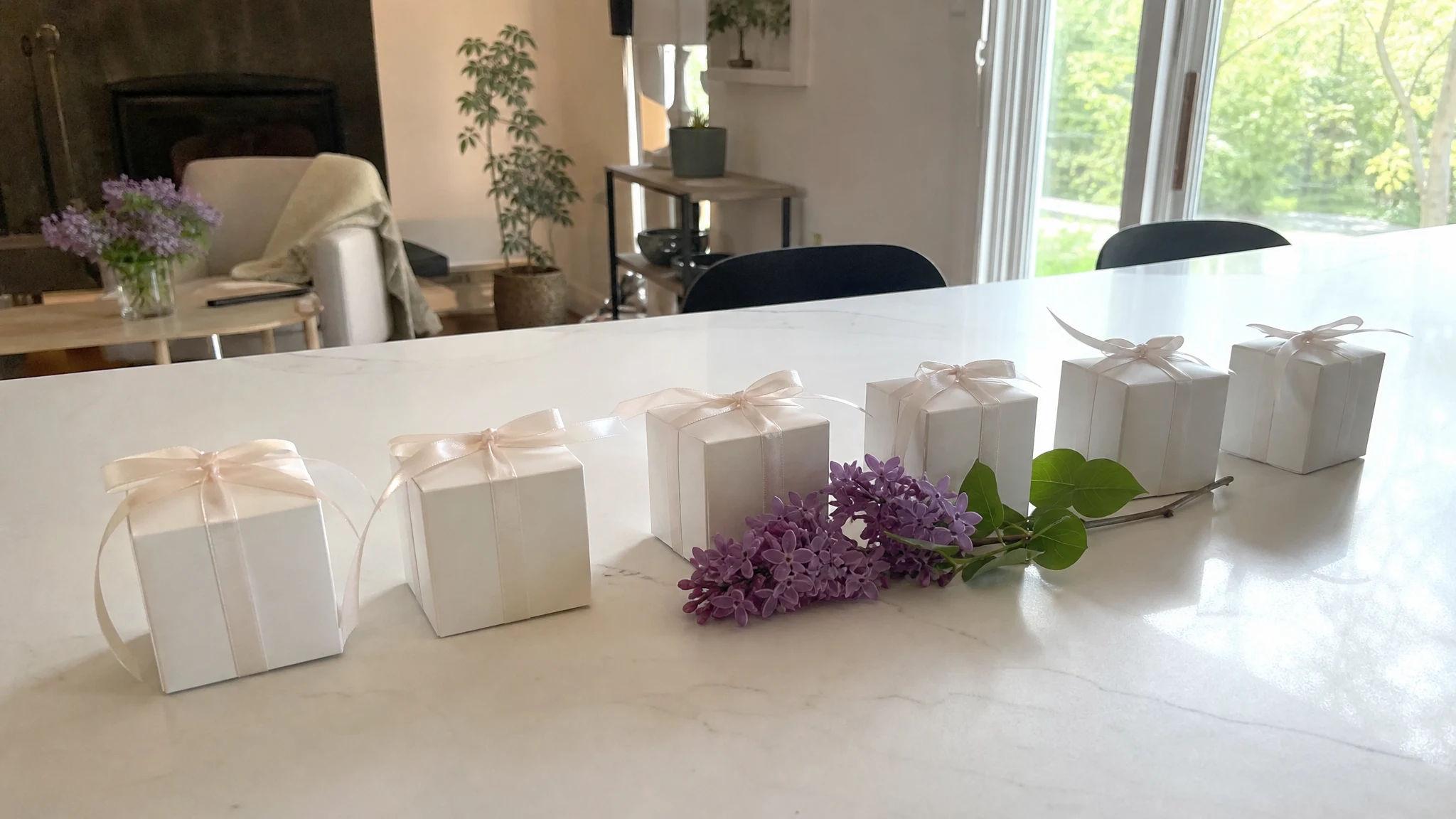
Lilac Wedding Favors: Quantities, Labels and Timing
A wedding is the wrong place to meet a scent for the first time. Guests will smell the favor months after you last smelled the oil, and a failed batch cannot be redone the week of the event. Our advice is to pick the favor type for what you can document and test, run a small batch six to twelve weeks out, and do the arithmetic before you choose a bottle size. Everything below is a plan worked out from cited guidance and our own figures. We have not made or tested a favor, and no customer has told us how one turned out.
Pick the favor by what you can document
Three favor types people reach for with a lilac oil, in the order we would rank them by how much unknown is attached to our oil:
| Favor | What the oil touches | What we cannot supply for our oil |
|---|---|---|
| Dried-material sachet | a fixative, then a cloth bag | allergen declaration; staining behaviour |
| Mini candle | wax, burning in a room | flash point, SDS, any burn behaviour |
| Balm tin or soap | guests' skin | IFRA certificate, allergen declaration, any skin data |
Our oil is a composition with undisclosed contents. The site publishes no IFRA certificate, allergen declaration, SDS or flash point for it, so no IFRA category limit can be calculated for it. The only ceiling we state for skin is our own copy: 0.5 to 2 percent in a carrier oil, patch test first, start low. That copy was written for one person on their own skin. A wedding favor goes to dozens of strangers, none of whom you can patch test. So our position: do not make a skin favor from this oil unless you have the documentation in writing and a cosmetic chemist or a dermatologist has looked at the formula. If you are buying for a product given away or sold, ask in writing before ordering and get the answer in writing.
The arithmetic, for 100 favors
We use the batch on the published COA: relative density 0.973, so 1 ml is about 0.973 g, about 20 drops per ml (weigh instead), 1 oz about 28.8 g, 0.5 oz about 14.4 g. The assumptions about favor size are ours, to show the method; replace them with yours.
Sachets. Take a 60 ml (about a quarter cup) bag per guest. 100 bags is 6,000 ml, about 6.3 quarts of dried mix. The University of Georgia Extension potpourri recipe uses 5 to 10 drops of essential oil with 1 oz of fixative for a 2-quart batch, added to the fixative first (UGA Bulletin 1170, 2008, rev. 2025). That recipe is for an essential oil; applying it to ours is inference. Scaled by 3.2: 16 to 32 drops, about 0.8 to 1.6 g of oil, plus about 3.2 oz (90 g) of orris root. A 0.5 oz bottle holds about 296 drops, so the bottle is not the limit. The fixative and the dried material are. Full method in lilac sachets and potpourri.
Candles. Take a 2 oz (about 57 g) wax fill per favor: 100 candles is about 5.7 kg of wax. Every 1 percent of fragrance load across that is 57 g of oil, about 2 oz. The load itself must come from the wax maker's data sheet for the wax you buy, not from us. As a worked example only: CandleScience's lab notes for one soy wax (EcoSoya CB-Advanced) recommend 6 to 9 percent fragrance and a cure of at least three days, while its product page for the same wax lists 10 percent for containers and a two-week cure (CandleScience lab notes; product page). Those are one wax and a fragrance oil of the maker's choosing, not our oil and not a rating for it, and the two pages disagree with each other. At 6 percent the oil is about 340 g, roughly 11.8 oz; at 9 percent, about 510 g, roughly 17.7 oz. That is more than the 16 oz bottle. The sizes run 0.5, 1, 2, 4, 8 and 16 oz, then 5, 25 and 400 lb, so a candle favor run at the higher end moves you to the pound sizes. See the shop page for the current price per size. The shop's bulk page says to test fragrance load at small scale before committing bulk oil; that is the shop's guidance, not a test result. For the soy method, see the soy candle article, and for flash point see the flash point article. We do not state a flash point, pour temperature or burn behaviour for our oil because the site has none.
Balm tins. For a 15 g tin, 0.5 to 2 percent is 0.075 to 0.30 g of oil, or about 1.5 to 6 drops per tin. For 100 tins that is 7.5 to 30 g, between about 0.26 and 1.04 oz. At the 2 percent end, a single 1 oz bottle (28.8 g) is just short. This applies our carrier-oil copy to a wax-and-oil balm, which is an extension we are not entitled to make, so treat the figure as the most the oil could be, not a recommendation.
The legal layer: a favor is still a product
The FDA tells small and home cosmetic makers that "if you manufacture or market cosmetics, you have a legal responsibility for the safety and labeling of your products," that the firm named on the label must ensure adequate substantiation of safety, and that a post office box or website is not an adequate address (FDA, content current 2025). Labels need the product's identity, net quantity, and name and place of business, and retail cosmetics need an ingredient list (FDA, 2025). The FDA's labeling guide excludes "samples distributed free of charge, unless such products are customarily also sold at retail" from the ingredient declaration (FDA, 2022). It does not say whether a wedding favor is a sample, and it does not carve the same exception for the name, address or net quantity. Whether your favor counts is a question for a regulatory consultant or a product-safety attorney, not for a recipe page. We would label the tin fully and list the ingredients, and we would still ask the supplier for the documentation first.
Candles carry their own risk. The National Fire Protection Association's analysis of 2014 to 2018 data counted an average of 7,610 home structure fires a year started by candles, with something flammable too close to the candle in 60 percent of them (NFPA, Ahrens, 2020). A guest's candle goes home with them, so the label is the only instruction it has; see candle warning label requirements. Guests with scent sensitivities or allergies are a reason to offer an unscented alternative, which is our suggestion rather than a sourced rule.
Working back from the date
Orders typically ship in 1 to 2 business days, and bulk can take longer. Then the cure: the extension sources for a sachet mix run from at least a month (Nebraska) to 4 to 5 weeks (Iowa State) to 2 months (Georgia). Candle cure is the wax maker's call. Our reasoning: one week for a small test batch, up to eight for the cure, one for assembly and two of slack puts the oil order about twelve weeks before the wedding. If the theme is blooming lilacs, remember the bloom moves: USA National Phenology Network observers reported common lilac open flowers on average on April 22 in 2012, the third earliest in a record from 1957, with a note that early reports may be over-represented (USA-NPN, 2014). The oil does not depend on the bloom, but the photographs do. For gift framing, see the gifts article.
If the favor has to be right, choose the sachet, run a small batch weeks ahead, and ask in writing for any document you would need before you hand a product to guests.
Lilac Blossom Oil
Lilac Blossom Oil from our own shop, in sizes from 0.5 oz to bulk.
From $15.99
Shop Now →Sources & Further Reading
- University of Georgia Extension, 2008 (rev. 2025). Bulletin 1170, Herbs in Southern Gardens. fieldreport.caes.uga.edu/B1170
- FDA, 2025. Small businesses and homemade cosmetics fact sheet. fda.gov/cosmetics/small-businesses-homemade-cosmetics
- FDA, 2025. Summary of cosmetics labeling requirements. fda.gov/cosmetics-labeling-regulations
- FDA, 2022. Cosmetics labeling guide. fda.gov/cosmetics-labeling-guide
- CandleScience. Lab notes: EcoSoya CB-Advanced soy wax, and product page. candlescience.com/lab-notes-ecosoya-cb-advanced
- Ahrens M, NFPA, 2020. Home candle fires. nfpa.org/osCandles.pdf
- USA National Phenology Network, 2014. Lilacs showed very early activity in 2012. usanpn.org/news/article
- Nebraska Extension (Frogge), 2021, and Iowa State University Extension: potpourri cure times. lancaster.unl.edu, yardandgarden.extension.iastate.edu