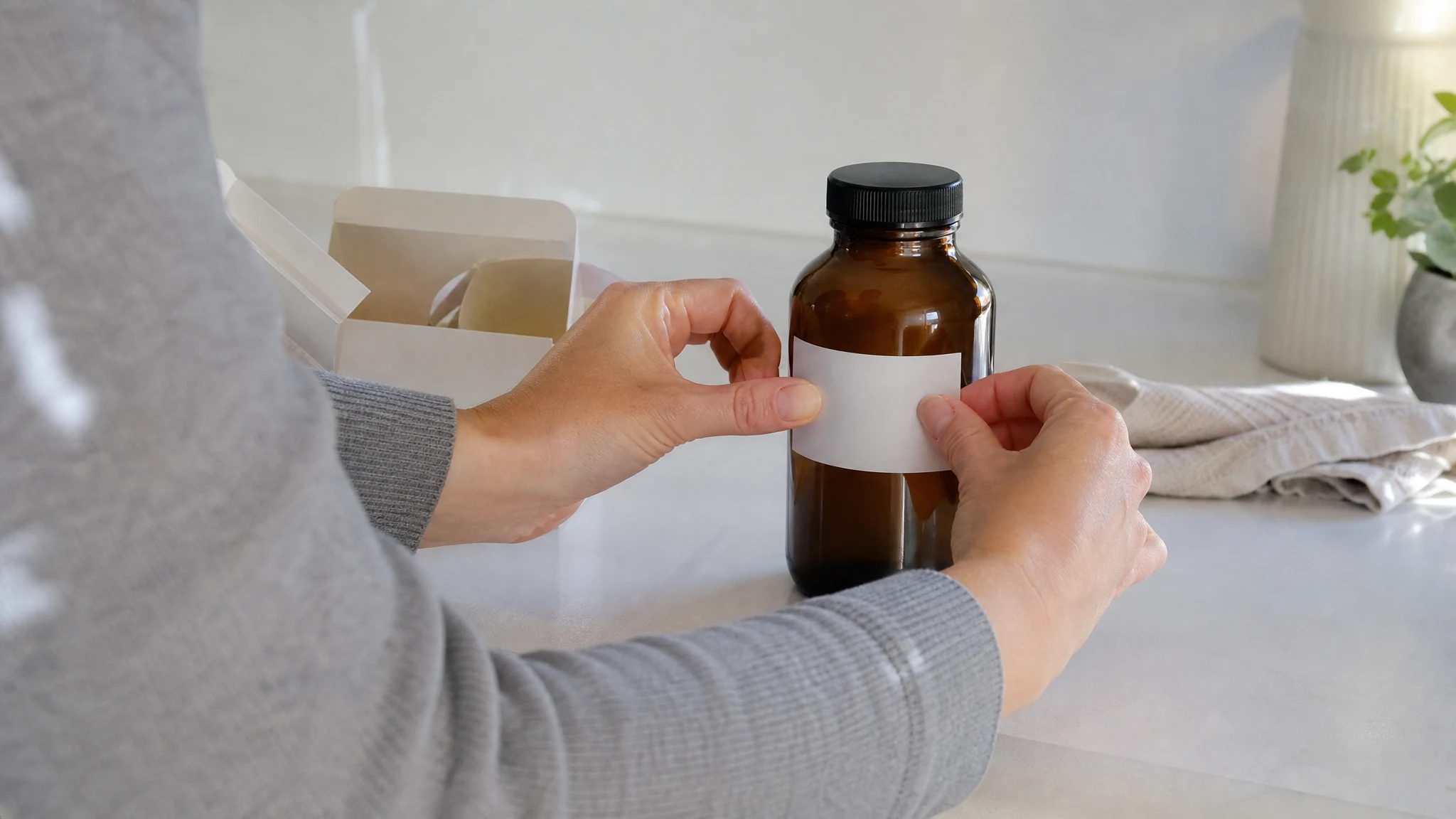
Private Label Lilac Products: What the Brand Owner Carries
Private label moves the oil's problems onto your label; it does not take them off your desk. Once your name is on a bottle, a candle or a bar of soap, the U.S. rules hold you as the party answerable for its labeling and safety, whoever filled the bottle. This guide is about what that means for a lilac product built on our oil, what our wholesale page does and does not say, and which questions to put in writing before you commit to a run.
What the wholesale page offers, in its own words
Our wholesale page describes private label as customizing your labels, bottles and packaging, with filling and capping done in-house on an automated line built for oil production, at a U.S.-based facility. It also offers sample bottles so you can evaluate the oil in your own product before committing to volume, custom formulations ("tell us what you have in mind and we will help where we can"), an account manager, and volume pricing on every size. That is the whole published offer.
What is not published: minimum order quantities, lead times, label formats, and what paperwork comes with a private-label order. Do not infer any of them. Use the wholesale consultation form on the wholesale page, ask for each item in writing, and keep the written answers with your product file.
Who is "the responsible person" when your name is on the label
FDA defines the responsible person for a cosmetic as the manufacturer, packer or distributor whose name appears on the label (FDA, MoCRA page). That responsible person must keep records supporting the product's safety and must report serious adverse events to FDA within 15 business days, including a copy of the label. FDA's small-business fact sheet, current as of 18 November 2025, puts it more plainly: it is your responsibility to make sure your labeling meets all requirements, and a manufacturer, packer or distributor must ensure adequate substantiation of safety (FDA, 2025). That page does not address private label arrangements specifically, so none of it says a contract filler takes the duty over. If your bottle says "Distributed by" or "Manufactured for" your brand, you are on the hook for the label.
That label wording is itself regulated. FDA's labeling summary (current as of 18 November 2025) requires the name and place of business of the firm marketing the product, with a qualifying phrase such as "Manufactured for" or "Distributed by" when that firm did not make or pack it, plus a statement of identity, net quantity, and an ingredient declaration in descending order of predominance (FDA, 2025; the underlying rule is 21 CFR 701.12).
The ingredient declaration is where our oil's design matters most
Our oil is a composition of botanical extracts and infused aromatics built to be faithful to the scent of the common lilac, and we say on our pages that we will not publish a formula. Put that next to the declaration rule. Under 21 CFR 701.3(a), fragrance may be listed simply as "fragrance," but "no ingredient may be designated as fragrance or flavor unless it is within the meaning of such term" (eCFR, 21 CFR 701.3), and the regulations define fragrance as any natural or synthetic substance used solely to impart an odor to a cosmetic product (eCFR, 21 CFR 700.3(d)). FDA's own fragrance page says fragrance and flavor formulas are the components most likely to be trade secrets, which is why the single word is allowed (FDA fragrances page, last updated 28 February 2022).
Whether our oil can be declared as the single word "fragrance" on your label is a regulatory judgment that depends on what is in it, and we do not publish that. We are not the right party to answer it for you. A regulatory consultant or a cosmetics attorney is. What you can do beforehand is ask us, in writing, what ingredient information we can supply for your declaration, and get the answer in writing. No ingredient statement, allergen declaration or IFRA certificate is published on our site, and we do not promise any specific document; a buyer who needs one should ask before ordering.
Fragrance allergens are a moving target, and two FDA pages disagree by date. The 2022 fragrance page says FDA does not have the same legal authority to require allergen labeling for cosmetics as for food. The MoCRA page, which is newer, lists "fragrance allergen labeling requirements" among the things the law has FDA establish, without describing the rules. Check the current FDA position with your consultant before the label is printed, and if you ever export, the destination's rules are a separate question this guide does not cover.
Claims on your label are your claims
FDA draws the cosmetic line by intended use: a cosmetic is for cleansing, beautifying, promoting attractiveness or altering appearance, while a product intended for treating or preventing disease is a drug even if it also affects appearance (FDA authority over cosmetics). Our pages make no medical claim for the oil and say its purpose is scent. That statement stays with our pages. If your label or listing says a lilac product relaxes, calms or helps with anything, the claim is yours, and so is the consequence. The same goes for any statement that the product suits skin, children, pregnancy or pets: we make none, and your label should not inherit one from a marketing page.
Candles carry a different rulebook
If the private-label product is a candle rather than a cosmetic, FDA is the wrong agency. The Consumer Product Safety Commission's candle page lists one mandatory rule: metal-cored wicks and candles that use them must not contain lead in the core above 0.06% by weight (16 CFR 1500.17(a)(13)), with a certificate for products subject to the rule. It also notes that candles containing a hazardous substance under the Federal Hazardous Substances Act need cautionary labeling, and it lists ASTM F2058, the candle fire safety labeling specification, as a voluntary standard (CPSC, candle business guidance). The page does not describe private labelers or reporting duties, so that gap goes to a product-safety attorney.
For our oil specifically, the site publishes no flash point, SDS or IFRA certificate, so a candle brand cannot build its safety file from our published pages. Our candle warning label guide covers the label side, and how to read a COA and SDS covers what you are asking for.
Questions to send before you commit
Put each of these in the wholesale form or in an email, and file the replies:
- Minimum order quantity, lead time and label format for private-label orders.
- What ingredient information can be provided for your own declaration, and in what form.
- Whether a safety data sheet, flash point, IFRA certificate or allergen declaration exists for the oil, and whether it can be shared. (None is published on our site.)
- How lots are tracked. Our bottles carry a lot number; ask whether it is carried through to your branded bottle and how you would trace a complaint.
- What happens if a later lot differs from the batch on the published COA. That COA (batch LILIBCUNINC001A, best by 05/31/2027) describes one batch; it shows appearance, smell, relative density 0.973, refractive index 1.501 and optical rotation -0.72, extraction "Blended," and nothing about constituents, allergens, flash point or origin.
- How a formulation change will be notified to you before your label becomes inaccurate.
Before any of that, run a sample through your own product at small scale, as our bulk guidance itself advises, and see testing before bulk. If you want the terms behind these documents in one place, the glossary defines them.
What small size does and does not change
FDA says MoCRA exempts certain small businesses from facility registration and product listing, but the exemption does not cover products that contact the eye's mucous membrane, injected products, products intended for internal use, or products that alter appearance for more than 24 hours (FDA, draft guidance announcement, a page current as of 8 November 2023 that describes guidance still in draft). The same pages leave the labeling and safety-substantiation duties above in place. Whether your business qualifies is a question for the consultant, not for a blog post.
If your plan is a small label you can launch in weeks rather than a regulated product line, start with the sample, the written questions above, and an hour with a regulatory consultant before the first print run.

Lilac Blossom Oil
Lilac Blossom Oil from our own shop, in sizes from 0.5 oz to bulk.
From $15.99
Shop Now →Sources & Further Reading
- U.S. FDA. Modernization of Cosmetics Regulation Act of 2022 (MoCRA). fda.gov/cosmetics/.../mocra
- U.S. FDA, current as of 18 November 2025. Small Businesses and Homemade Cosmetics: Fact Sheet. fda.gov/.../small-businesses-homemade-cosmetics-fact-sheet
- U.S. FDA, current as of 18 November 2025. Summary of Cosmetics Labeling Requirements. fda.gov/.../summary-cosmetics-labeling-requirements
- U.S. FDA, 2022. Fragrances in Cosmetics. fda.gov/cosmetics/cosmetic-ingredients/fragrances-cosmetics
- U.S. FDA. FDA Authority Over Cosmetics: How Cosmetics Are Not FDA-Approved, but Are FDA-Regulated. fda.gov/.../fda-authority-over-cosmetics
- U.S. FDA, 2023. FDA Issues Draft Guidance on Registration and Listing of Cosmetic Product Facilities and Products. fda.gov/.../draft-guidance-registration-and-listing
- eCFR. 21 CFR 701.3 (ingredient declaration), 701.12 (name and place of business), 700.3 (definitions). ecfr.gov/title-21/part-701
- U.S. Consumer Product Safety Commission. Candles (business guidance). cpsc.gov/.../Candles