Wick Size for Lilac Soy Candles: Chart, Test, Adjust
The wick, not the oil, is the first thing to change when a lilac candle tunnels or the scent seems to vanish. A wick chart gives you a starting series for your wax and jar diameter, and the supplier guides we read say the same thing about it: it is a starting point that your own burn test has to confirm. This post is about doing that in the right order, and about what we cannot tell you for our own oil.
Start with the jar, then the chart, and distrust any chart without a stated load
CandleScience's wick guide opens with the variable that matters most: "wax type and candle diameter." You find your wax, find your container's inner diameter, and read the wick series where they meet (CandleScience, wick guide, 2026). The footnote is the part most reproduced charts drop. That guide states its recommendations assume a candle made "without color" and with "1.2 ounces per pound (or 7.5%) of fragrance oil." Heavily dyed or heavily scented candles, it says, "may require a larger size than the guide recommends."
The percentage is worth checking, because 1.2 ounces per pound is 1.2 divided by 16 ounces, which is 7.5% of the wax weight. So a chart row for a jar is a statement about one particular fragrance weight and no dye. A chart that does not say what load and color it assumed cannot be adjusted for your candle, and we would not size from it.
Worked through for a jar holding 8 oz of wax (226.8 g): 7.5% is 17.0 g of fragrance, and the 1 oz per pound mark (6.25%) is 14.2 g. The gap between the two is under 3 g, which is how thin the line is between the chart's assumption and the point where the supplier says to start moving the wick. A candle poured at a higher load than the chart assumed is therefore already in adjustment territory, before any dye goes in.
What fragrance and dye do to the wick you picked
CandleScience's guide on wicking container candles gives the adjustment in plain terms: more than 1 oz of fragrance oil per pound of wax (about 28 g per 454 g, or 6.25%), a dense fragrance, or a lot of dye or dark color means wick up one or two sizes. Less than 1 oz per pound, a thin fragrance, or no dye means wick down one or two sizes (CandleScience, wicking container candles, 2026). Its wick guide adds the mechanism: heavy, dense or viscous scents are "harder for the wick to pull up, resulting in a weak flame," while lighter citrus or floral oils "might cause the same wick to burn hot."
Note the two pages differ slightly on dye. The wick guide says to "size up by one wick size when adding moderate to heavy color"; the container page says one or two sizes. That is a named disagreement inside one supplier, and it is a good reason to bracket rather than guess: test the chart size and one size either side.
Lilac is a floral, but that sentence is about a class of oils, not about ours. The thing you cannot get from any article, including this one, is how a particular lilac composition changes a particular wick. We publish no burn data, no flash point and no safety data sheet for our Lilac Blossom Oil, and we have not poured a candle with it. Reasoning from the supplier's floral note, the possibility is that a floral burns hotter than the chart row predicts, which would point you to test one size down as well as one up. That is a reason to test, not a prediction.
A test routine you can copy exactly
CandleScience's burn test procedure is specific enough to follow without improvising (CandleScience, how to conduct a burn test, 2026):
- Cure the finished candle at least 24 hours before testing, and record wax, fragrance, fragrance load, dye and amount, wick and container.
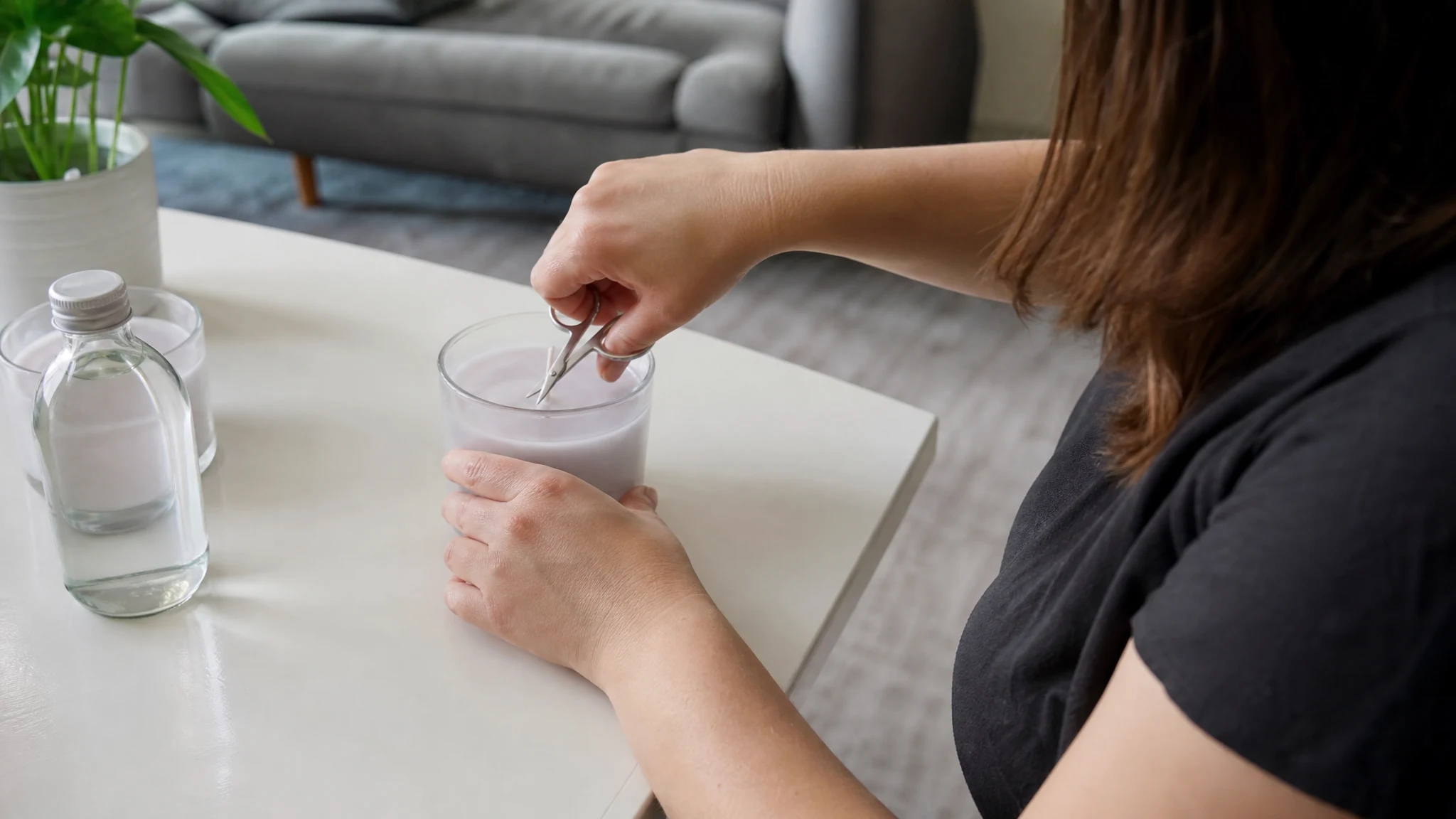
- Trim the wick to 1/4 inch (6 mm) before every lighting.
- Check each hour and record what you see. Extinguish after four hours, let the candle cool at least five hours, and repeat until 1/4 inch (6 mm) of wax remains.
- Judge the melt pool only from the fourth burn cycle on. At three to four hours it should reach no more than 1/4 inch (6 mm) from the container edge.
- Do not swap wicks mid-test, and do not burn longer than four hours at a time.
The container-candle page adds how to arrange the trial: make two or three candles with the same jar, wax, fragrance and dye, each with a different wick from the same series, label the jars, wait at least 24 hours, and burn them side by side. Adjust within the series before trying another series.
Reading the result
| What you see | Likely reading (CandleScience) | Move |
|---|---|---|
| Tunneling, small flame, weak scent | Under-wicked | Wick up one size |
| Ring of unmelted wax after the fourth cycle | Under-wicked | Wick up |
| Mushrooming, tall flame, hot jar, fast burn-down | Over-wicked | Wick down |
| Large plumes of soot, repeatedly | Too much fuel for the wick, or wrong wick | Wick down; check dye and load |
| Flame about 1 inch, melt pool edge to edge | Properly wicked | Keep, then judge hot throw |
The same sources disagree on how deep the melt pool should be. The container-candle page gives 1/4 to 3/4 inch (6 to 19 mm); the burn test page says typically 1/4 to 1/2 inch (6 to 13 mm). Both agree on a flame of about an inch, with the burn test page allowing up to two inches as normal. When two documents from one supplier differ, write down which you used, so your next candle is judged by the same yardstick.
Throw comes last, and wick comes before oil
CandleScience says to finish the burn test and settle the wick before judging hot throw. That order matters for lilac. The shop's bulk page says the oil has a "decent throw in wax melts and cold-process soap, though like most florals it reads softer than heavier musks or woods." If your first candle smells faint, an undersized wick is a more likely cause than the oil, and raising the fragrance load while the wick is wrong adds fuel the wick cannot carry. Our companion posts cover the weak-throw fix and the choice of wax, and the existing step-by-step for scenting soy candles with lilac oil covers the pour itself.
Before you pour any candle for sale
Two things have to be in place that this post cannot supply. First, the site publishes no flash point, safety data sheet or IFRA certificate for our oil, so ask in writing before ordering and keep the written answer. How to read what comes back is in how to read a fragrance oil COA and SDS, and the flash point post covers why that number matters in a hot wax pot. Second, wicks, wax and jars are not things we sell; buy them from a candle supply shop that publishes its wick chart with the assumed load and color, and use that shop's series names, not ours.
We have not tested any wick with our oil, so the honest recommendation is the supplier's own: test small, test three sizes, and judge after four burn cycles. The oil is on the shop page when your wick is settled.

Lilac Blossom Oil
Lilac Blossom Oil from our own shop, in sizes from 0.5 oz to bulk.
From $15.99
Shop Now →Sources & Further Reading
- CandleScience, 2026. Candle wick guide. candlescience.com/learning/wick-guide
- CandleScience, 2026. How to properly wick container candles. candlescience.com/learning/wicking-container-candles
- CandleScience, 2026. How to conduct a burn test. candlescience.com/learning/how-to-conduct-a-burn-test