Lilac Lotion: Scenting a Ready-Made Base
Few things say spring like a hand lotion that smells of lilac, and it is easier to make than most people think, as long as you start in the right place. The oil is the fun part. The smart part is choosing a base that someone else has already built and preserved, so all you have to do is scent it.
Why we start with a ready-made base
A lotion is mostly water, and water-rich products are exactly where bacteria and mold like to settle in. The FDA says microbial contamination is a common reason for cosmetic recalls, and it lists an ineffective preservation system among the causes. A from-scratch emulsion needs the right emulsifier, oil phase, water phase, preservative and pH, and nothing you do at a kitchen counter proves that the preservative is doing its job. A cosmetic chemist or a cosmetic-chemistry textbook is the place to learn that craft, and it is a good craft to learn.
For a scented lotion, our suggestion is simpler: buy an unscented lotion base from a cosmetic supply shop, one the maker describes as already preserved, and add only the lilac oil. We sell just the oil, so the base comes from a craft or cosmetic supplier. Resist stretching the base with extra water, hydrosol or aloe, since that dilutes the preservative the maker designed. Clean jars, clean spoons and dry hands matter too.
How much lilac oil to add
Our dilution guidance for skin is 0.5% to 2% in a carrier, patch tested first, starting low. For a leave-on lotion we would begin at 0.5% to 1%. That sits inside the 1% to 3% Tisserand Institute lists for body oils and lotions, and a little under the 0.5% to 1.2% it lists for facial products, so if you plan to use the lotion on your face, stay at the bottom of our range.
The Certificate of Analysis we publish for one batch gives a relative density of 0.973, so a milliliter weighs about 0.97 g, and a dropper delivers about 20 drops per milliliter, give or take. In numbers:
| Oil share | In 100 g of base | In 250 g of base |
|---|---|---|
| 0.5% | 0.5 g, about 10 drops | 1.25 g, about 26 drops |
| 1% | 1 g, about 21 drops | 2.5 g, about 51 drops |
| 2% | 2 g, about 41 drops | 5 g, about 103 drops |
At this scale a scale beats a dropper. A thin oil drops differently from a thick one, and on a 100 g jar at 0.5% a miscount of two drops changes the dose by a fifth. Weigh the base into the jar, weigh the oil in, and stir until the mix looks uniform. If the base maker states its own limit for added fragrance, treat the lower of that figure and ours as your ceiling.
Expect a soft lilac
Lilac is a heart note. We describe the scent as soft, powdery and springlike, with fresh purple florals, green stems, a hint of almond sweetness and a clean musky base, and that gentleness is part of its charm. In a lotion it will read as a quiet bloom that drifts up when you rub your hands together, not as a perfume. If you want more presence, consider the base: lotions with their own strong aroma will overpower it, which is why unscented is worth the search. Our post on why more oil is not the lever for lasting scent explains why a higher load rarely solves it.
Stirring it in, and letting it rest
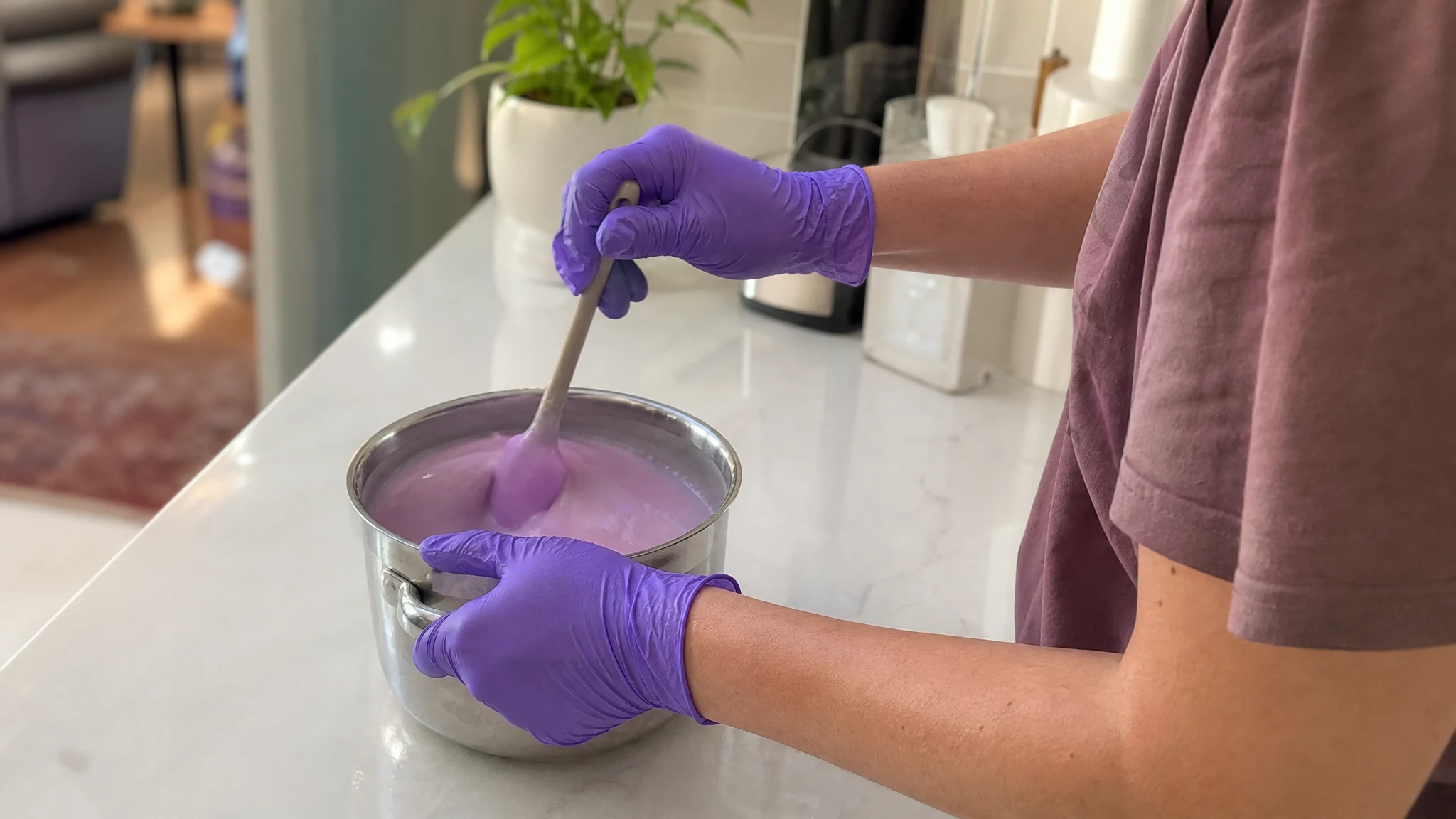
Use a clean bowl and a clean spatula, add the oil to the base a little at a time, and stir slowly so you do not whip in air. Then close the jar and leave it overnight before you judge the scent. Lilac is a gentle floral, and on the first day you may notice it seems louder or flatter than it will settle to be.
Make a small jar first, label it with the date and the oil share, and keep it away from heat and sun. A little is enough: you are looking for a quiet bloom, not a perfume. If you love the result, repeat the same amounts next time and the jar will smell the way you remember.
Patch test, and who should check first
Fragrance is among the better-documented causes of contact allergy. A cross-sectional study across five European countries, with more than 3,000 people patch tested, put fragrance contact allergy in the general population at about 1.9%, and about twice as common in women. That does not describe our oil specifically, but it is a good reason to patch test any scented leave-on. Dab a little of the finished lotion, not only the oil, on a small area and wait before using it widely. If you have eczema, a known fragrance allergy or reactive skin, check with a dermatologist before using any scented leave-on. Keep it away from eyes, children and pets. Our oil is for external aromatic and cosmetic use only.
If you plan to sell it
The FDA's fact sheet for small businesses is blunt: you carry the legal responsibility for the safety and labeling of your products. If a lotion will leave your kitchen, you will want written information about the oil in your file. Ask us in writing through the contact page before ordering, and keep the answer. Our dilution chart and the post on a softly floral body oil are good next reads for a water-free alternative.
A jar of lilac lotion on the bedside table is a nice way to hold on to a short season, and a good base makes it a five-minute job.

Lilac Blossom Oil
Lilac Blossom Oil from our own shop, in sizes from 0.5 oz to bulk.
From $15.99
Shop Now →Sources & Further Reading
- Microbiological Safety and Cosmetics (FDA)
- Small Businesses & Homemade Cosmetics: Fact Sheet (FDA)
- Dilution for essential oils (Tisserand Institute)
- Prevalence of fragrance contact allergy in the general population of five European countries: a cross-sectional study (Diepgen et al., British Journal of Dermatology, 2015)