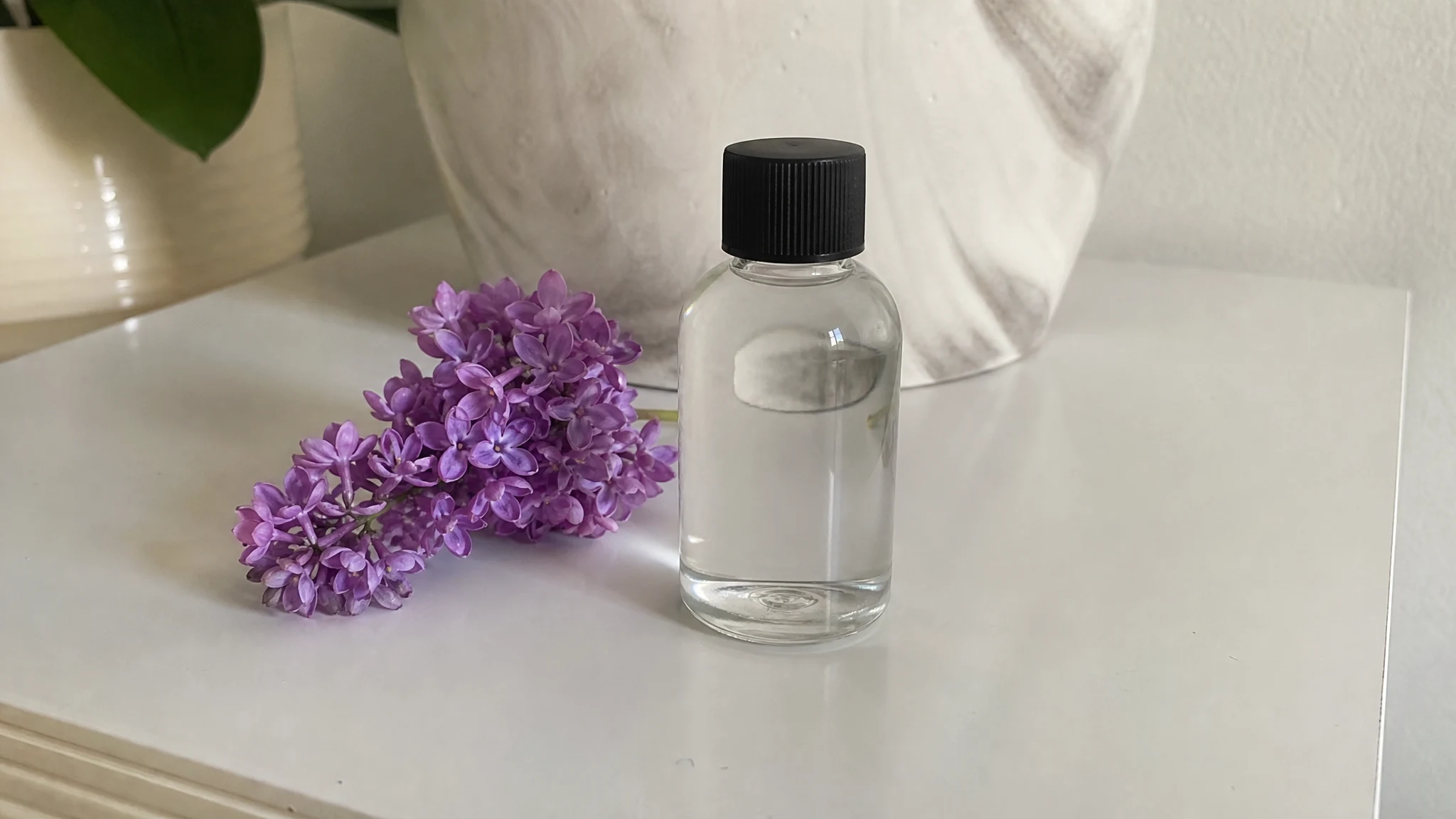
Lilac Rollerball Perfume: A 10 ml Recipe Drop by Drop
The best thing about a rollerball is how little goes into it. One to four drops of lilac oil in a 10 ml bottle makes a quiet, wearable scent for wrists and neck, the kind you notice when you lift your hand to your face. It is a small project with a lot of charm, and the arithmetic fits on a napkin.
What 2% looks like in a small bottle
Our guidance for skin is to dilute lilac oil to 0.5% to 2% in a carrier oil, patch test first and start at the low end. The Certificate of Analysis we publish for one batch gives a relative density of 0.973 at 20 C, so a milliliter weighs about 0.97 g. With about 20 drops per milliliter (droppers vary), a 10 ml roller works out like this:
| Oil share | Oil in 10 ml | About how many drops |
|---|---|---|
| 0.5% | 0.05 ml | 1 |
| 1% | 0.10 ml | 2 |
| 2% | 0.20 ml | 4 |
At this size each drop is half a percentage point, so a fifth drop takes you from 2% to 2.5%, past our range. That is the whole reason rollerballs are quiet: there is simply very little room. If you want more presence, add a day of patience before more oil. Our post on why more oil is not the lever for lasting scent explains what actually carries a floral on skin.
Why we stay below the bigger numbers
You will find rollerball recipes at 3% to 10%. The Tisserand Institute's dilution page lists that range for pain and "feel good" rollerballs, alongside 0.5% to 1.2% for facial cosmetics and 1% to 3% for body oils and lotions, and it describes these as useful guidelines rather than rules. They are written for essential oils with known constituents, and our oil is a composition we do not publish a formula for. When two figures disagree about a material, we take the lower one. So our rollerball stays inside 0.5% to 2%, and a first batch at 1% leaves room on both sides.
Picking a carrier for the roller
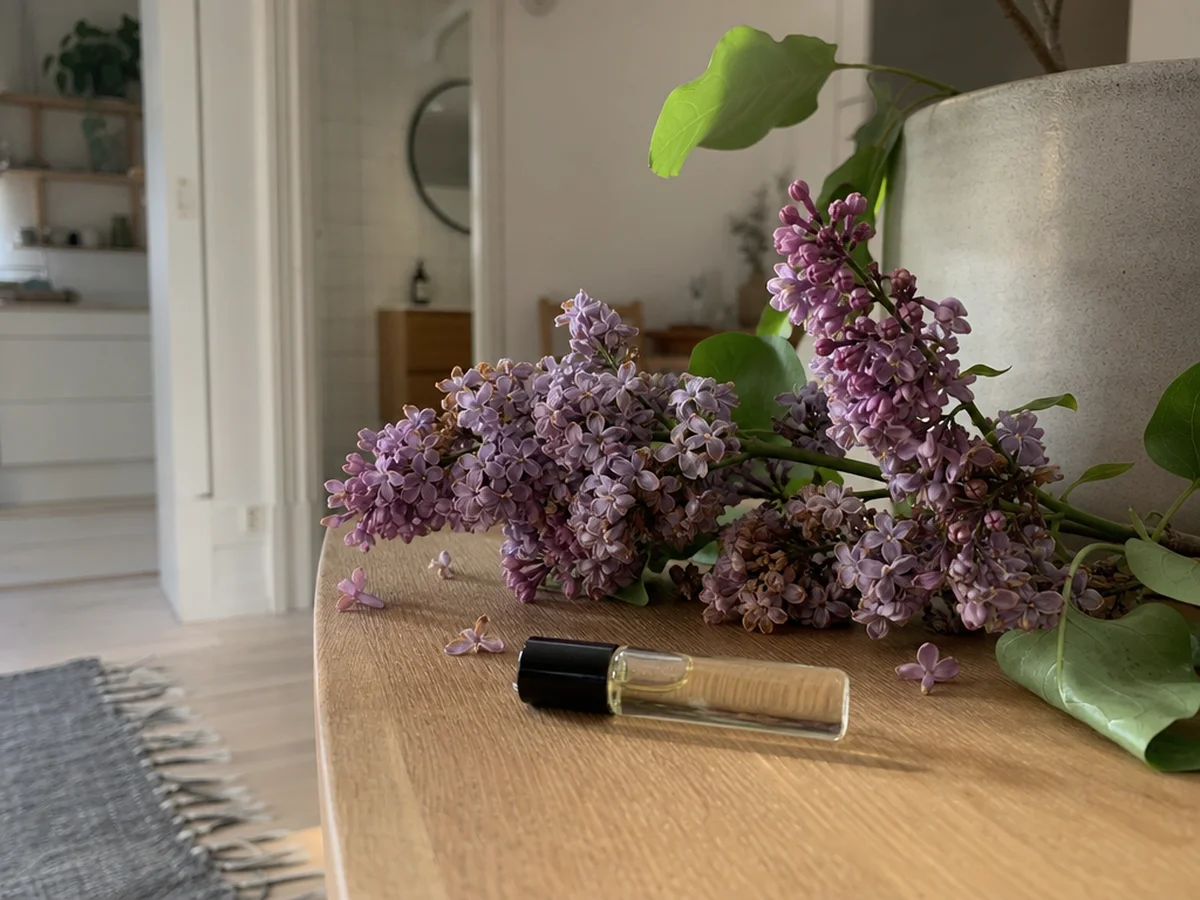
The carrier is the quiet half of a rollerball. A very light, almost scentless oil lets the lilac speak for itself, while a richer oil adds its own faint smell and a slightly heavier feel on the skin. Open the carrier bottle and smell it before you use it; if it has a strong character of its own, it will sit under the lilac the whole time you wear it. Rub a drop between your fingers too, because an oil that feels greasy in the bottle will feel greasy on your wrist. A lighter touch usually makes a more pleasant everyday scent.
The build
- Pick the percentage. For a first bottle, 1% is two drops.
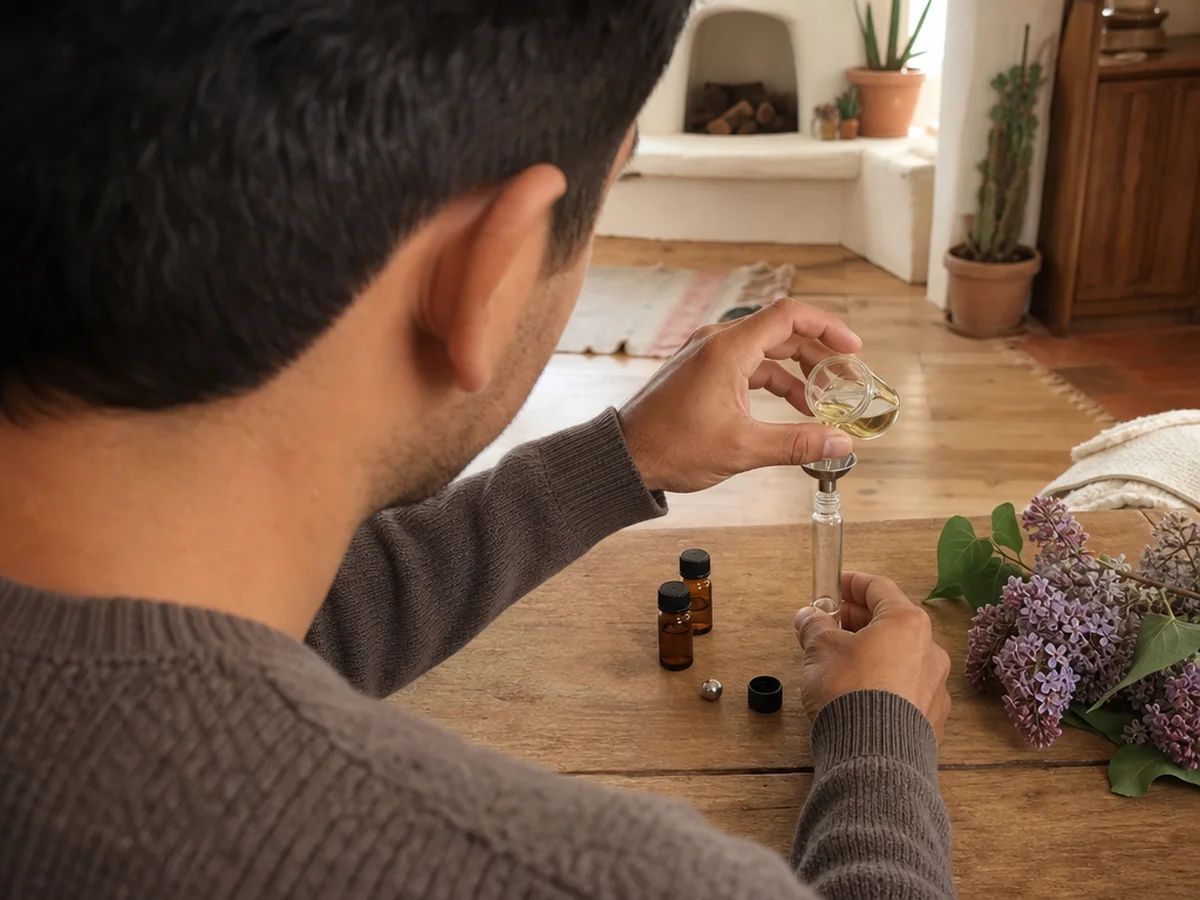
- Fill a clean 10 ml roller bottle with a carrier oil, almost to the top, leaving room for the lilac oil and the roller ball. We sell only the lilac oil, so a craft or soap supply shop is the place for the bottle and a lightly scented carrier such as jojoba or fractionated coconut.
- Add the lilac oil last, by weight on a 0.01 g scale if you have one, otherwise by counting drops from a dropper you have checked once against a scale.
- Press in the roller, cap, and turn the bottle gently to mix.
- Label it with the oil, the percentage and the date, and patch test on a small area before wearing it on wrists or neck.
Keep it water-free. Adding hydrosol or an alcohol-water mix makes a different product with its own preservation questions, which is why our post on lilac lotion points to a ready-made base. If you prefer a wax format, a solid perfume has its own tin-sized arithmetic.
Scent on skin
A roller bottle puts the oil right where your pulse warms it, which is why so few drops go so far. Lilac is a heart note, softly powdery with a green edge, and on warm skin it tends to bloom for a while and then settle into the musky base. Apply to clean, dry skin, and give it a few minutes before deciding whether it is enough. Noses adapt to a scent worn all day, so judge it again after stepping into fresh air.
Making it a keepsake
A rollerball is a lovely little gift, and a handwritten label makes it feel personal. Note the lilac, the date and the percentage, and add a line saying it is for external use, to be patch tested first and kept away from eyes. A small box or a scrap of fabric around the bottle turns an afternoon's project into something people keep in a coat pocket for the season. If you are making several, line the bottles up and fill them one after another from the same carrier, so every roller smells the same.
After a first batch, let the bottle rest for a day before you wear it, then judge it with a fresh nose. It is a good habit with any scent you have just mixed.
If you plan to sell it
IFRA sorts finished products into categories by how they meet the body. Fine fragrance, including solid perfume, is Category 4, described as generally applied to the neck, face and wrists, and body oils and lotions are Category 5A. A rollerball is not named in the guidance, so which category fits is a decision for whoever formulates it. Reasoning from where it is worn, a wrist-and-neck perfume oil sits closest to Category 4. The FDA's small-business fact sheet notes you are legally responsible for the safety and labeling of what you sell. If that is you, ask us in writing through the contact page for what you need before ordering, and keep the written answer.
A lilac rollerball in a coat pocket is a small, private spring, and it starts with a single drop.
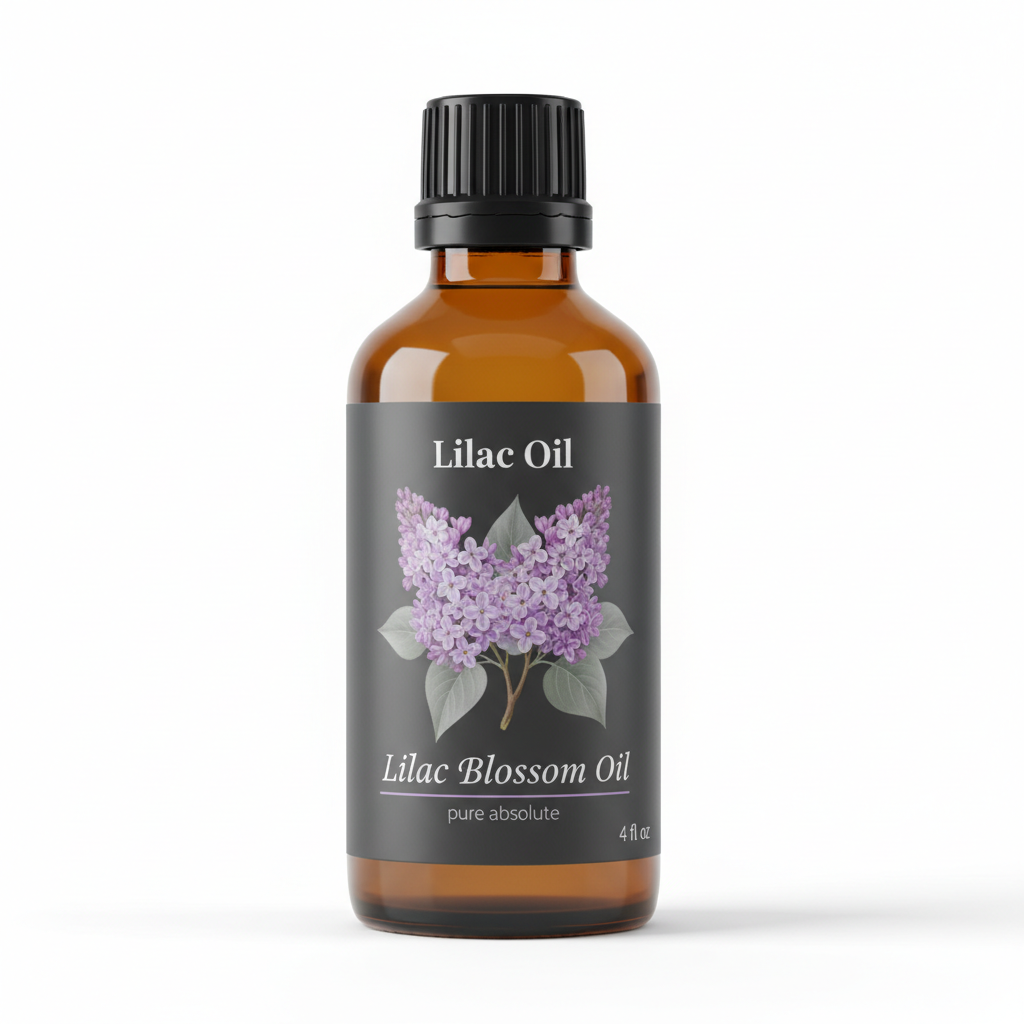
Lilac Blossom Oil
Lilac Blossom Oil from our own shop, in sizes from 0.5 oz to bulk.
From $15.99
Shop Now →Sources & Further Reading
- Dilution for essential oils (Tisserand Institute)
- Guidance for the use of the IFRA Standards, 51st Amendment (IFRA, 2023)
- Small Businesses & Homemade Cosmetics: Fact Sheet (FDA)